
Acknowledgement: Mr John Matthews
Few political labels are used as readily, or as imprecisely, as “fascism”. It is sometimes treated as a synonym for dictatorship, political cruelty or any form of nationalism. Yet fascism emerged from a particular crisis of European mass politics after the First World War. Its movements rejected liberal democracy and Marxist socialism, celebrated hierarchy and violence, and promised to regenerate a nation supposedly weakened by division, decadence and internal enemies.
There was no single fascist manifesto followed identically across Europe. Italian Fascism and German National Socialism differed in important ways, especially over the place of biological racism and antisemitism. They nevertheless shared a political style: the cult of a leader, paramilitary activism, mass mobilisation, contempt for pluralism and a myth of national rebirth. Fascism is best understood not as an ancient doctrine revived intact, but as a modern revolutionary response to democracy, war and social change.1
A Roman symbol in modern politics
The word “fascism” is connected to the Italian fascio, meaning a bundle or association. It also evoked the Roman fasces: rods bound around an axe and carried before magistrates as an emblem of public authority. Benito Mussolini’s movement appropriated this imagery to present itself as disciplined, united and heir to imperial Rome.2

The symbol should not be mistaken for the origin of the ideology. Ancient Rome supplied a political language and a repertoire of spectacle, but fascism belonged to the twentieth century. Its uniforms, rallies, propaganda, party organisation and claims to embody “the people” depended upon modern mass communication and mass participation. The appeal to Rome was a selective invention of tradition: a way of clothing a new movement in the authority of an imagined past.3
War, revolution and the crisis of liberal government
The First World War transformed European political life. It normalised mass mobilisation, sharpened national hatreds, expanded state power and left millions of veterans confronting bereavement, economic dislocation and uncertain social status. The Russian Revolution of 1917 added a powerful fear of Bolshevism among property owners, conservatives and sections of the middle class. Fascist movements exploited these conditions, but anti-communism alone does not explain their rise.4
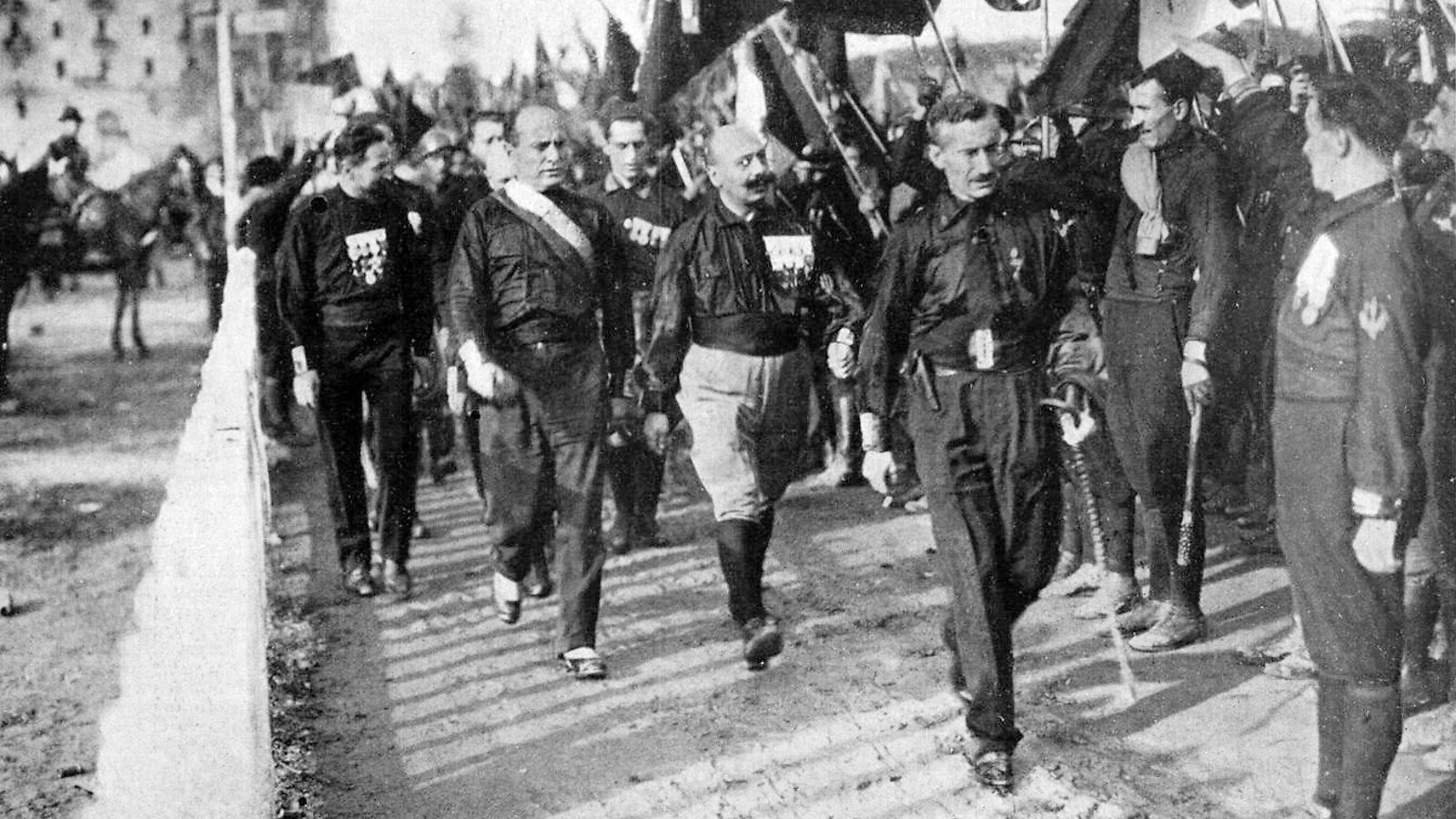
Post-war Italy experienced inflation, strikes, land occupations and disappointment over the peace settlement. Liberal governments appeared unable to contain political violence. Fascist squads attacked socialist organisations, trade unions, newspapers and local administrations, frequently benefiting from the tolerance or support of landowners, industrialists, police and conservative officials. Fascism grew through a combination of activism from below and accommodation by established elites.5
Mussolini and the destruction of Italian democracy
Mussolini had been a prominent socialist journalist and editor of Avanti!, but he broke with the Italian Socialist Party in 1914 because he supported intervention in the war. His turn was therefore nationalist and pro-war, not “anti-war”. In 1919 he founded the Fasci Italiani di Combattimento; the National Fascist Party followed in 1921.6

The March on Rome in October 1922 was later celebrated as a heroic seizure of power. In reality, Fascist violence created the threat while political and monarchical decisions opened the government to Mussolini. King Victor Emmanuel III refused to approve martial law and appointed him prime minister. Mussolini initially headed a coalition; he then dismantled parliamentary government through intimidation, legislation and murder. By 1925-26, opposition parties and an independent press had been suppressed and dictatorship consolidated.7
The regime promoted the Duce as the embodiment of national will, organised youth and leisure, and sought to discipline labour and culture. It never eliminated every older institution: monarchy, Church, bureaucracy and private property remained. This did not make it politically moderate. Fascist dictatorship rested upon the destruction of opposition, imperial warfare – most brutally in Ethiopia – and attempts to penetrate social life through party and state institutions.8
Nazism, race and expansion
German National Socialism belonged to the broader fascist family, but racial antisemitism stood at its ideological centre. Adolf Hitler did not emerge from a socialist or communist movement. The Nazi Party’s use of the term “socialist” did not signify a commitment to Marxism, worker control or equality. Nazis violently opposed communists, social democrats and independent trade unions, replacing class conflict with the racial community of the Volksgemeinschaft.9
Nazi ideology imagined history as a racial struggle. It combined older Christian and secular antisemitism with modern racial pseudoscience, conspiracy theory and social Darwinist language. The term “Aryan”, originally employed in linguistic and historical discussions, was detached from those contexts and transformed into a false biological category. Scholarship did not lead naturally to Nazism: racial ideologues selected, distorted and politicised ideas for exclusionary ends.10

Hitler’s demand for Lebensraum, or “living space”, directed German expansion towards eastern Europe. Conquest, racial reordering and annihilation were connected ambitions rather than separate excesses. The Nazi state progressively excluded Jews from citizenship and economic life before pursuing deportation and systematic murder. Six million Jews were killed in the Holocaust11, alongside the persecution and murder of Roma, disabled people, Soviet prisoners of war, Polish civilians, political opponents, homosexual men and others targeted by the regime.
Paramilitary violence and political power
Violence was not merely a tool used after fascists reached office. It helped create fascist political identity. Italy’s squadristi and Germany’s Sturmabteilung, or SA, offered comradeship, status and a sense of purpose, particularly to some veterans and younger activists. They broke meetings, destroyed offices, assaulted opponents and made ordinary democratic organisation dangerous.12
These movements portrayed violence as cleansing and creative. Enemies were represented not simply as people with competing views, but as contaminants preventing national unity. That logic made compromise appear treacherous and coercion virtuous. Once in government, fascists combined party violence with police power, courts, prisons and concentration camps. The boundary between movement and state shifted, but the attempt to eliminate legitimate opposition remained fundamental.13
Economy, society and the myth of total unity
Fascist regimes presented themselves as alternatives to both capitalism and socialism. In practice, they destroyed autonomous labour organisations and retained private ownership while directing production towards national and military goals. Business elites could benefit from repression of the left, although they did not simply control fascist governments. The regimes sought to subordinate economic interests to political priorities rather than abolish class or property.14
It is misleading to rank fascist and communist regimes through a simple claim that one allowed “more freedom”. Different dictatorships developed different institutions and degrees of control, and these changed over time. A more useful approach asks how coercion, consent, bureaucracy, social participation and ideological ambition interacted in each case. Fascist rule was never omnipotent, but it destroyed civil and political liberties and exposed targeted populations to escalating state violence.15
Interpreting the authoritarian personality
After the Second World War, Theodor W. Adorno and his collaborators attempted to explain the psychological dispositions that could make authoritarian politics attractive. The Authoritarian Personality (1950) connected rigid conventionalism, submission to authority and aggression towards perceived outsiders. Its “F-scale” sought to measure tendencies associated with susceptibility to fascism.16
The project was influential but controversial. Critics questioned its methods, its assumptions about personality and its tendency to locate authoritarianism primarily on the political right. Its continuing value lies less in offering a timeless diagnostic test than in directing attention to the relationship between social experience, prejudice and political authority. Fascism cannot be explained by personality alone; institutions, ideology, crisis and organised movements matter.17
Using the term carefully
Not every dictatorship or radical nationalist party is fascist. The category is most useful when it identifies a combination of features: exclusionary ultranationalism, a promise of collective rebirth, hostility to pluralist democracy, celebration of hierarchy and organised violence, and mobilisation behind an authoritative leader or movement. Historical comparison can reveal family resemblances without pretending that every case is identical.18
This precision matters in discussions of contemporary extremism. Symbols, conspiracy theories and fantasies of national decline can migrate into new settings, but resemblance is not proof of direct continuity. Calling every opponent fascist empties the term of explanatory value; refusing to recognise adapted forms can be equally dangerous. Intellectual history helps by reconstructing how political languages were formed, appropriated and made persuasive.
Conclusion
Fascism did not descend directly from Roman symbolism, arise solely as a reaction to communism or represent an ordinary authoritarian preference for order. It was a modern form of mass politics that promised national regeneration through unity, hierarchy and struggle. Its leaders reached power not only through propaganda and popular support, but through paramilitary violence and bargains made by conservative elites who believed they could use or contain them.
The Italian and German cases also demonstrate why distinctions within fascism matter. Mussolini’s dictatorship supplied an influential model, while Nazism placed racial empire and genocidal antisemitism at the centre of its programme. Studying both together reveals shared structures; studying them separately preserves the particular ideas, institutions and crimes that broad labels can conceal.
Related Reading
Continue exploring related themes across The Intellectual Historian:
- George Orwell: Truth, Language and Democratic Socialism
- Louis Althusser: Ideology, Institutions and the Politics of Philosophy
- Empire after Empire? Soviet Rule, Decolonisation and the Politics of Collapse
Notes
- Robert O. Paxton, The Anatomy of Fascism (London: Allen Lane, 2004), 3–23; Roger Griffin, The Nature of Fascism (London: Routledge, 1991), 26–55. ↩
- Emilio Gentile, Fascism: History and Interpretation, trans. Chiara M. Boutin (Madison: University of Wisconsin Press, 2003), 1–31. ↩
- Gentile, Fascism, 31–55. ↩
- Paxton, Anatomy of Fascism, 41–65; Stanley G. Payne, A History of Fascism, 1914–1945 (London: UCL Press, 1995), 73–96. ↩
- Paxton, Anatomy of Fascism, 59–78. ↩
- Gentile, Fascism, 55–82; Payne, History of Fascism, 96–111. ↩
- Paxton, Anatomy of Fascism, 87–105. ↩
- Gentile, Fascism, 165–209. ↩
- Ian Kershaw, Hitler, 1889–1936: Hubris (London: Allen Lane, 1998), chs. 5–8; Claudia Koonz, The Nazi Conscience (Cambridge, MA: Belknap Press of Harvard University Press, 2003), 1–32. ↩
- Koonz, Nazi Conscience, 33–100. ↩
- United States Holocaust Memorial Museum, “Introduction to the Holocaust,” Holocaust Encyclopedia, accessed September 16, 2026, https://encyclopedia.ushmm.org/content/en/article/introduction-to-the-holocaust; Koonz, Nazi Conscience, 201–53. ↩
- Paxton, Anatomy of Fascism, 55–87. ↩
- Paxton, Anatomy of Fascism, 119–48. ↩
- Paxton, Anatomy of Fascism, 119–48; Payne, History of Fascism, 394–440. ↩
- Payne, History of Fascism, 441–99. ↩
- Theodor W. Adorno et al., The Authoritarian Personality (New York: Harper, 1950), 222–79. ↩
- Richard Christie and Marie Jahoda, eds., Studies in the Scope and Method of “The Authoritarian Personality” (Glencoe, IL: Free Press, 1954). ↩
- Griffin, Nature of Fascism, 26–55; Paxton, Anatomy of Fascism, 206–20. ↩
Bibliography
- Adorno, Theodor W., Else Frenkel-Brunswik, Daniel J. Levinson, and R. Nevitt Sanford. The Authoritarian Personality. New York: Harper, 1950.
- Christie, Richard, and Marie Jahoda, eds. Studies in the Scope and Method of “The Authoritarian Personality.” Glencoe, IL: Free Press, 1954.
- Gentile, Emilio. Fascism: History and Interpretation. Translated by Chiara M. Boutin. Madison: University of Wisconsin Press, 2003.
- Griffin, Roger. The Nature of Fascism. London: Routledge, 1991.
- Kershaw, Ian. Hitler, 1889–1936: Hubris. London: Allen Lane, 1998.
- Koonz, Claudia. The Nazi Conscience. Cambridge, MA: Belknap Press of Harvard University Press, 2003.
- Paxton, Robert O. The Anatomy of Fascism. London: Allen Lane, 2004.
- Payne, Stanley G. A History of Fascism, 1914–1945. London: UCL Press, 1995.
- United States Holocaust Memorial Museum. “Introduction to the Holocaust.” Holocaust Encyclopedia. Accessed September 16, 2026. https://encyclopedia.ushmm.org/content/en/article/introduction-to-the-holocaust.
Article word count: 1,518 words
Cite this article
Chicago style: Samuel Woodall, “Fascism: Symbols, Violence and the Politics of National Rebirth,” The Intellectual Historian, 16 October 2024, https://theintellectualhistorian.com/2024/10/16/the-origins-of-fascism-from-roman-symbols-to-modern-extremism/.
Leave a Reply