
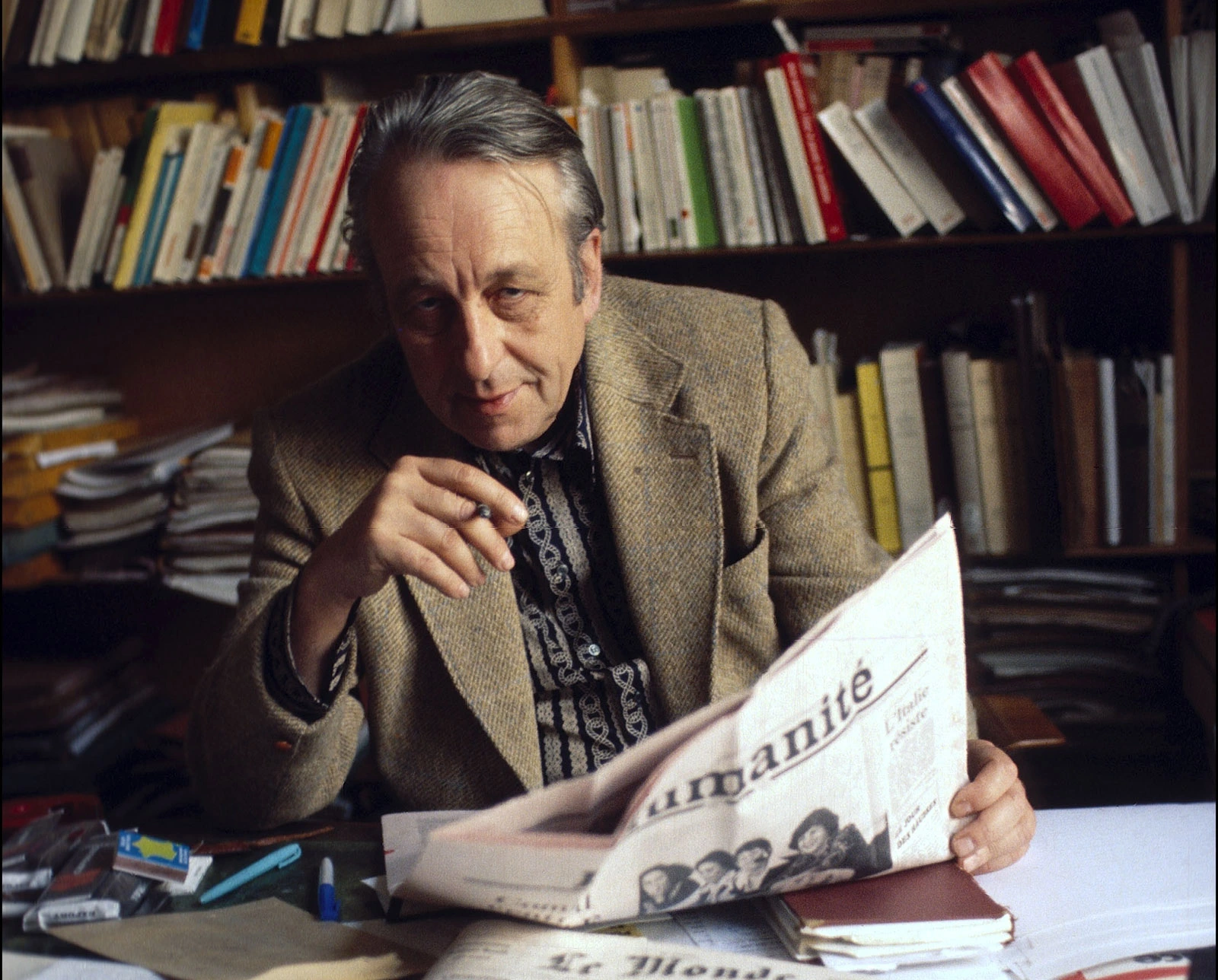
Louis Althusser reshaped twentieth-century Marxism by asking how social systems reproduce themselves and how individuals come to recognise their place within them. His answer moved beyond the idea that ideology is simply a collection of lies imposed by a ruling class. Ideology is embedded in institutions, rituals and ordinary practices; it helps form people as subjects who experience the social order as intelligible and natural.
Althusser also challenged the image of philosophy as a politically innocent search for timeless truth. Philosophical arguments draw boundaries between science and ideology, legitimate and illegitimate questions, and materialist and idealist accounts of the world. For Althusser, those boundaries have political stakes even when philosophers deny them.1
A Marxist philosopher in post-war France
Althusser was born in French Algeria in 1918, studied at the École Normale Supérieure in Paris and later taught there for decades. After spending much of the Second World War as a prisoner of war, he joined the French Communist Party in 1948. His most influential books, For Marx and Reading Capital, appeared in 1965 during intense debates about Stalinism, decolonisation, structuralism and the future of communist politics.2

Althusser’s life was marked by recurrent and severe mental illness. In 1980 he killed his wife, the sociologist and former Resistance member Hélène Rytmann, during a psychiatric crisis. He was found unfit to stand trial and confined to psychiatric care. This tragedy cannot be converted into a simple explanation of his philosophy, but neither should an intellectual biography erase it.3
Reading Marx against humanism
Many Marxist interpretations treated history as the progressive realisation of a human essence alienated under capitalism. Althusser rejected this “humanist” framework. He argued that Marx’s mature critique of political economy broke with the philosophical anthropology of his earlier writings. Rather than beginning with an abstract idea of humanity, analysis should examine historically specific relations of production, institutions and concepts.
This was Althusser’s controversial claim of an “epistemological break” between the young and mature Marx. The break was not a single moment at which every old idea disappeared. It named a transformation in the questions Marx asked and the conceptual tools through which capitalism became an object of knowledge.4
Althusser’s method of “symptomatic reading” looked for what a text could not formulate as well as what it openly said. A theoretical work may produce a new problem without possessing all the concepts required to state it consistently. Reading therefore reconstructs the structure of questions that makes both the text’s insights and its silences possible.5
Structure, contradiction and overdetermination
Althusser opposed a mechanical model in which the economy directly causes every political or cultural event. A social formation contains economic, political and ideological practices with different histories and degrees of relative autonomy. Economic relations remain decisive “in the last instance”6, but their effects operate through institutions and conflicts that cannot be reduced to simple reflections.
He borrowed the term “overdetermination” to describe contradictions shaped by several conditions at once. A revolution, for example, cannot be explained by one economic contradiction unfolding automatically. State crisis, war, class organisation, political leadership, national histories and ideology may converge. This approach attempted to preserve materialist explanation without treating history as inevitable.7
Ideology as a lived relationship
In “Ideology and Ideological State Apparatuses”, Althusser defined ideology as the imagined relationship of individuals to their real conditions of existence. “Imaginary” does not mean merely invented or unreal. People live social relations through images, rituals and assumptions that organise how the world and their own place within it appear.8
Ideology has a material existence because it is enacted. Attending school, participating in worship, following workplace procedures, consuming news or performing family roles involves repeated practices. Beliefs are sustained through institutions and habits rather than residing only as propositions inside an individual mind.9
This account explains why exposing a false statement is rarely enough to dissolve an ideology. Individuals may recognise contradictions and still participate in the practices that reproduce them. Ideology is durable because it is woven into everyday conduct and social belonging.
Interpellation: becoming a subject
Althusser used “interpellation” to describe how ideology addresses individuals and forms them as subjects. His famous example is a police officer calling “Hey, you there!”10 When the person turns around, they recognise that the call is directed at them and enter a relationship of authority.
The scene is illustrative rather than a literal account of a subject’s first beginning. Names, family roles, citizenship, education, gender and occupation provide positions through which people recognise themselves long before any single encounter. Subjecthood has a double meaning: a person becomes an apparently free agent while also becoming subject to the structures that make that identity available.11
Repressive and ideological state apparatuses
Althusser distinguished the Repressive State Apparatus – including government, police, courts, prisons and the military – from Ideological State Apparatuses such as schools, churches, families, media, political organisations and cultural institutions. The distinction concerns their predominant mode of operation. Repressive institutions rely principally upon coercion, while ideological apparatuses work principally through consent, formation and recognition; both use mixtures of force and ideology.12
The plural is important. Ideological apparatuses are not one perfectly coordinated machine. They can embody competing traditions and become sites of struggle. Schools may reproduce workplace discipline and social hierarchy while also providing knowledge with which students challenge them. Institutions are politically consequential without every participant consciously serving a single ruling-class plan.13
The reproduction of social relations
A mode of production must reproduce more than tools and raw materials. It requires workers with particular skills, habits and expectations, along with institutions capable of maintaining property and authority. In modern capitalist societies, Althusser argued, education had become especially important because it distributed qualifications while teaching conduct: punctuality, obedience, hierarchy and the apparently neutral rules of social organisation.14
This does not mean that every lesson contains explicit capitalist propaganda. Reproduction often occurs through the organisation of time, assessment and credentials. The strength of Althusser’s account lies in making these routine mechanisms visible. Its weakness is the danger of treating successful reproduction as the normal outcome and leaving too little space for agency, failure and institutional change.
Lenin and philosophy as political practice
In the essays collected as Lenin and Philosophy, Althusser presented philosophy as “class struggle in theory”15. The phrase did not mean that every philosophical sentence is dictated directly by a political party. Philosophy intervenes by drawing lines: between idealism and materialism, science and ideology, or politically consequential and supposedly neutral ways of framing a problem.
Lenin mattered to Althusser because he refused to treat theory and political organisation as separate worlds. Revolutionary practice required analysis, while theoretical positions had practical effects. Philosophy could not command science or politics from above, but it could intervene in disputes over their concepts and limits.
The claim that there is “no innocent reading”16 follows from this approach. Readers bring concepts and theoretical assumptions to a text; evidence never organises itself without questions. This does not make rigorous interpretation impossible. It requires readers to identify their method and test it rather than mistake unexamined assumptions for neutrality.
Criticism and afterlives
Althusser’s anti-humanism and structural language attracted substantial criticism. E. P. Thompson accused him of producing an abstract system detached from historical experience. Others argued that interpellation explains obedience more readily than resistance, or that the theory assigns institutions functions they do not perform consistently.17
Althusser repeatedly revised his positions. His later writings on “aleatory materialism” placed greater emphasis upon encounters, contingency and the absence of a guaranteed historical destination. Across cultural studies, feminist theory and political philosophy, thinkers including Stuart Hall and Judith Butler adapted interpellation while giving more attention to contradictory identities, failed recognition and the possibility that subjects respond unexpectedly to the terms that address them.18
Conclusion
Althusser’s importance lies in shifting ideology from the realm of bad ideas into the organisation of social life. Institutions reproduce relations of power not only by commanding people, but by teaching them how to recognise authority, competence, normality and themselves. Philosophy participates by establishing the concepts through which those relations are understood.
His framework should not be treated as a closed system in which resistance is impossible and truth merely expresses class interest. Used critically, it supplies a set of questions: which practices sustain this belief, which institutions authorise it, what kind of subject does it call into being, and where does the process fail? Those questions explain why Althusser remains relevant to intellectual history.
Related Reading
Continue exploring related themes across The Intellectual Historian:
- Michel Foucault: Power, Knowledge and the Practice of History
- George Orwell: Truth, Language and Democratic Socialism
- Postcolonial Thought: Bhabha, the Global South and Cultural Boundaries
READ · LISTEN · DISCUSS
Marx, Althusser and social reproduction
- Listen: Industrialisation and Karl Marx
- Discuss: How Does a Social Order Reproduce Itself?
Notes
- Gregory Elliott, Althusser: The Detour of Theory, 2nd ed. (Leiden: Brill, 2006), 55–97; Warren Montag, Althusser and His Contemporaries: Philosophy’s Perpetual War (Durham, NC: Duke University Press, 2013), 1–18. ↩
- Luke Ferretter, Louis Althusser (London: Routledge, 2006), 2–3; Elliott, Althusser, 1–53. ↩
- Ferretter, Louis Althusser, chap. 6. ↩
- Louis Althusser, For Marx, trans. Ben Brewster (London: Allen Lane, 1969), 31–38. ↩
- Louis Althusser and Étienne Balibar, Reading Capital, trans. Ben Brewster (London: New Left Books, 1970), 28–32. ↩
- Althusser, For Marx, 111–13. ↩
- Althusser, For Marx, 87–128. ↩
- Louis Althusser, “Ideology and Ideological State Apparatuses,” in Lenin and Philosophy and Other Essays, trans. Ben Brewster (London: New Left Books, 1971), 162. ↩
- Althusser, “Ideology and Ideological State Apparatuses,” 165–70. ↩
- Althusser, “Ideology and Ideological State Apparatuses,” 174. ↩
- Althusser, “Ideology and Ideological State Apparatuses,” 170–83. ↩
- Althusser, “Ideology and Ideological State Apparatuses,” 142–48. ↩
- Louis Althusser, On the Reproduction of Capitalism: Ideology and Ideological State Apparatuses, trans. G. M. Goshgarian (London: Verso, 2014), 232–72. ↩
- Althusser, On the Reproduction of Capitalism, 232–72. ↩
- Louis Althusser, “Philosophy as a Revolutionary Weapon,” in Lenin and Philosophy and Other Essays, 13–26, at 18. ↩
- Althusser and Balibar, Reading Capital, 14–15. ↩
- E. P. Thompson, The Poverty of Theory and Other Essays (London: Merlin Press, 1978), 1–129. ↩
- Louis Althusser, “The Underground Current of the Materialism of the Encounter,” in Philosophy of the Encounter: Later Writings, 1978–87, ed. François Matheron and Oliver Corpet, trans. G. M. Goshgarian (London: Verso, 2006), 163–207; Stuart Hall, “Signification, Representation, Ideology: Althusser and the Post-Structuralist Debates,” Critical Studies in Mass Communication 2, no. 2 (1985): 91–114; Judith Butler, The Psychic Life of Power: Theories in Subjection (Stanford, CA: Stanford University Press, 1997), 106–31. ↩
Bibliography
- Althusser, Louis. For Marx. Translated by Ben Brewster. London: Allen Lane, 1969.
- Althusser, Louis. Lenin and Philosophy and Other Essays. Translated by Ben Brewster. London: New Left Books, 1971.
- Althusser, Louis. On the Reproduction of Capitalism: Ideology and Ideological State Apparatuses. Translated by G. M. Goshgarian. London: Verso, 2014.
- Althusser, Louis. Philosophy of the Encounter: Later Writings, 1978–87. Edited by François Matheron and Oliver Corpet. Translated by G. M. Goshgarian. London: Verso, 2006.
- Althusser, Louis, and Étienne Balibar. Reading Capital. Translated by Ben Brewster. London: New Left Books, 1970.
- Butler, Judith. The Psychic Life of Power: Theories in Subjection. Stanford, CA: Stanford University Press, 1997.
- Elliott, Gregory. Althusser: The Detour of Theory. 2nd ed. Leiden: Brill, 2006.
- Ferretter, Luke. Louis Althusser. London: Routledge, 2006.
- Hall, Stuart. “Signification, Representation, Ideology: Althusser and the Post-Structuralist Debates.” Critical Studies in Mass Communication 2, no. 2 (1985): 91–114.
- Montag, Warren. Althusser and His Contemporaries: Philosophy’s Perpetual War. Durham, NC: Duke University Press, 2013.
- Thompson, E. P. The Poverty of Theory and Other Essays. London: Merlin Press, 1978.
Article word count: 1,401 words
Cite this article
Chicago style: Samuel Woodall, “Louis Althusser: Ideology, Institutions and the Politics of Philosophy,” The Intellectual Historian, 8 October 2024, https://theintellectualhistorian.com/2024/10/08/althusser-redefining-philosophy-as-a-political-tool/.
Leave a Reply