
Introduction: Music as an Instrument of Political Mobilisation
Music can become a powerful instrument of political mobilisation because it allows large groups to express identity, memory, and dissent collectively without taking up arms. This capacity was especially visible during the Baltic “Singing Revolution,” when Estonia, Latvia, and Lithuania used songs, festivals, and cultural gatherings in their campaigns to restore national independence. As Guntis Šmidchens argues, singing did more than accompany political change: it helped create a disciplined, non-violent national culture capable of confronting Soviet authority.1
Traditional and newly composed songs enabled participants to turn inherited culture into public political language. Singing together made national identity audible, gave individuals confidence through the presence of a crowd, and allowed demonstrations to communicate unity without abandoning non-violent methods. Music therefore worked simultaneously as cultural preservation, emotional reassurance, and political action.2
The Baltic Way and Cultural Mobilisation
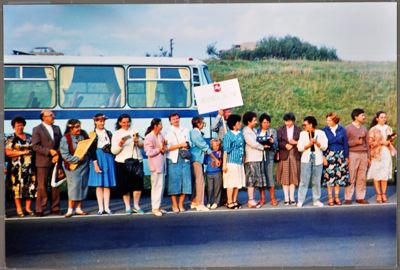
This cultural mobilisation formed part of the political environment that produced the Baltic Way on 23 August 1989. Around two million people joined hands across Estonia, Latvia, and Lithuania, creating a human chain of roughly 600 kilometres on the fiftieth anniversary of the Molotov–Ribbentrop Pact. The demonstration linked the three republics physically and symbolically while drawing international attention to their demand for freedom.3
Connect with My Research
For visual breakdowns, primary-source imagery, and short-form video analyses accompanying this piece, see my latest Instagram post.
The Baltic Way was not simply a logistical achievement. Its political force came from transforming individual participation into a visible experience of collective belonging. Song strengthened that effect. Familiar melodies, national languages, and shared performance linked the immediate protest to longer histories of cultural survival. The trilingual song The Baltics Are Waking Up, composed for the event, captured the cooperation among the three national movements while preserving their distinct voices.4
| Medium | Political function | Strategic impact |
|---|---|---|
| Traditional and patriotic songs | Preserved language and historical memory | Reasserted national identity |
| Mass song festivals | Repurposed established cultural institutions | Made solidarity visible on a vast scale |
| Contemporary popular music | Reached younger and urban audiences | Connected cultural revival with political change |
Comparative Regional Musical Strategies
The three republics shared a commitment to independence and non-violent mobilisation, but their musical cultures gave the movement different emphases. These distinctions should not obscure the extensive exchange and solidarity among Baltic activists; rather, they show how a common political strategy could grow from several national traditions.5
- Estonia: choral tradition and popular music. Estonia’s long-established song-festival culture provided both a physical setting and a familiar form of mass participation. In the late 1980s, patriotic choral singing interacted with contemporary popular music, including Alo Mattiisen’s “Five Patriotic Songs,” helping bring national political claims into mass public gatherings.6
- Latvia: folklore, poetry, and historical memory. Latvian mobilisation drew on choral traditions, folk culture, and the political resonance of national poetry. Jānis Kudiņš’s study of three Latvian songs shows how works associated with the period became historical symbols of non-violent resistance. Songs such as Mārtiņš Brauns’s Saule, Pērkons, Daugava, setting words by Rainis, joined cultural memory to demands for national renewal.7
- Lithuania: song, faith, and Sąjūdis. In Lithuania, patriotic songs and religious hymns carried particular moral weight within a society shaped by strong Catholic traditions. Their use at gatherings associated with Sąjūdis connected political sovereignty with historical memory, spiritual endurance, and peaceful civic action.8
Institutional Paradoxes and the Erosion of Hegemony
The Singing Revolution also reveals a central paradox of late Soviet rule. Institutions intended to display harmony among the Soviet “friendship of peoples” preserved national languages, performance traditions, organisational networks, and large public venues. Under glasnost, these resources could be redirected towards demands that challenged the legitimacy of Soviet authority. Karsten Brüggemann’s work on the Soviet roots of the Singing Revolution emphasises how Baltic cooperation emerged partly through institutions and practices created within the Soviet system itself.9
This did not mean that song alone brought down Soviet rule. Political organisations, mass demonstrations, legal arguments, international attention, and changes within the Soviet Union were all essential. Music’s distinctive contribution was to bind these elements together emotionally and symbolically. It helped political movements sustain participation, claim public space, and present independence as the restoration of legitimate national communities rather than a narrow contest for power.10
Conclusion
The Baltic Singing Revolution and the Baltic Way demonstrate how cultural practices can acquire direct political force. Traditional music, choir festivals, hymns, and popular songs gave Estonia, Latvia, and Lithuania a shared language of non-violent resistance while allowing each nation to draw on its own history. The human chain of August 1989 made Baltic unity visible to the world; collective singing made that unity audible and emotionally durable.11
The achievement of independence cannot be reduced to music, yet neither can music be treated as decoration surrounding the “real” politics. Singing enabled people to experience themselves as members of a sovereign public before sovereignty had been restored. In that sense, cultural memory became a form of political practice—one that weakened Soviet ideological authority and helped millions imagine, organise, and demand a different future.12
Related Reading
Continue exploring related themes across The Intellectual Historian:
- Empire after Empire? Soviet Rule, Decolonisation and the Politics of Collapse
- Postcolonial Thought: Bhabha, the Global South and Cultural Boundaries
- George Orwell: Truth, Language and Democratic Socialism
Notes
- Guntis Šmidchens, The Power of Song: Nonviolent National Culture in the Baltic Singing Revolution (Seattle: University of Washington Press, 2014), 1–14. ↩
- Šmidchens, Power of Song, 160–328. ↩
- UNESCO, “The Baltic Way—Human Chain Linking Three States in Their Drive for Freedom,” Memory of the World Register, accessed September 15, 2026, https://www.unesco.org/en/memory-world/baltic-way-human-chain-linking-three-states-their-drive-freedom; Vytautas Mazur, “The Baltic Chain’s Political Impact and Memory Politics,” Pasado y Memoria 31 (2025): 85–107. ↩
- Jānis Kudiņš, “Phenomenon of the Baltic Singing Revolution in 1987–1991: Three Latvian Songs as Historical Symbols of Non-Violent Resistance,” Muzikologija 26 (2019): 27–39, https://doi.org/10.2298/MUZ1926027K. ↩
- Šmidchens, Power of Song, 160–306. ↩
- Šmidchens, Power of Song, 160–260. ↩
- Kudiņš, “Phenomenon of the Baltic Singing Revolution,” 28–36. ↩
- Šmidchens, Power of Song, 261–306. ↩
- Karsten Brüggemann, “Doing It the ‘Baltic Way’: Internationalism and the Soviet Roots of the Singing Revolution,” in Ethnic Relations in the Baltic Reconsidered, ed. Bradley Woodworth, Violeta Davoliūtė, and Darius Staliūnas (Budapest: Central European University Press, 2026), 193–218, https://doi.org/10.5117/9789048570447_ch08. ↩
- Mazur, “Baltic Chain’s Political Impact,” 85–107; Brüggemann, “Doing It the ‘Baltic Way,’” 193–218. ↩
- Šmidchens, Power of Song, 307–28; UNESCO, “Baltic Way.” ↩
- Šmidchens, Power of Song, 307–28; Mazur, “Baltic Chain’s Political Impact,” 85–107. ↩
Bibliography
- Brüggemann, Karsten. “Doing It the ‘Baltic Way’: Internationalism and the Soviet Roots of the Singing Revolution.” In Ethnic Relations in the Baltic Reconsidered, edited by Bradley Woodworth, Violeta Davoliūtė, and Darius Staliūnas, 193–218. Budapest: Central European University Press, 2026. https://doi.org/10.5117/9789048570447_ch08.
- Kudiņš, Jānis. “Phenomenon of the Baltic Singing Revolution in 1987–1991: Three Latvian Songs as Historical Symbols of Non-Violent Resistance.” Muzikologija 26 (2019): 27–39. https://doi.org/10.2298/MUZ1926027K.
- Mazur, Vytautas. “The Baltic Chain’s Political Impact and Memory Politics.” Pasado y Memoria: Revista de Historia Contemporánea 31 (2025): 85–107.
- Šmidchens, Guntis. The Power of Song: Nonviolent National Culture in the Baltic Singing Revolution. Seattle: University of Washington Press, 2014.
- UNESCO. “The Baltic Way—Human Chain Linking Three States in Their Drive for Freedom.” Memory of the World Register. Accessed September 15, 2026. https://www.unesco.org/en/memory-world/baltic-way-human-chain-linking-three-states-their-drive-freedom.
Article word count: 846 words
Cite this article
Chicago style: Samuel Woodall, “The Political Power of Song in the Baltic Way and the Collapse of Soviet Rule,” The Intellectual Historian, 10 September 2026, https://theintellectualhistorian.com/2026/09/10/the-political-power-of-song-in-the-baltic-way-and-the-collapse-of-soviet-rule/.
Leave a Reply