
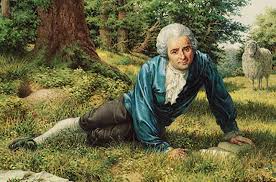
Jean-Jacques Rousseau is often introduced through a handful of memorable formulas: humanity is naturally good, society corrupts it, and legitimate government rests upon the “general will”. These summaries capture something of his challenge to eighteenth-century Europe, but they can also conceal the tensions that make his work enduring. Rousseau criticised civilisation while writing for its literary public, defended freedom while demanding obedience to law, and developed an educational ideal whose promise was divided sharply by gender.
Rather than treating Rousseau simply as a precursor of Romanticism, socialism, liberal democracy or the French Revolution, intellectual history asks what problems he was addressing in his own language and circumstances. Across his writings, one problem recurs: how did human beings capable of independence and compassion become dependent upon status, comparison and the judgement of others?1
A Genevan outsider
Rousseau was born in Geneva in 1712 and repeatedly identified himself as a citizen of that republic. His life nevertheless unfolded across a Francophone European world. He left Geneva as a young man, converted temporarily to Catholicism, worked as a tutor, secretary, copyist and composer, and entered the Parisian circles associated with Denis Diderot and the Encyclopédie. His relationship with Enlightenment sociability was always uneasy: he depended upon patrons and print while becoming one of the most powerful critics of polite, commercial civilisation.2

This position as both participant and outsider shaped his authorial identity. Rousseau often presented himself as persecuted, misunderstood and morally isolated. His autobiographical writings made personal sincerity into a philosophical problem: could the self be known and represented honestly in a society governed by appearances?3
The First Discourse: progress without virtue
Rousseau became famous after answering the Academy of Dijon’s question about whether the revival of the arts and sciences had purified morals. His Discourse on the Sciences and Arts (1750) gave a deliberately provocative answer: intellectual and artistic refinement could coexist with moral corruption. Politeness might conceal rivalry, vanity and dependence rather than cultivate civic virtue.4
The argument was not a rejection of knowledge as such. Rousseau questioned the assumption that accumulating knowledge automatically made societies or citizens better. Learning could serve luxury, reputation and political domination. The division of intellectual labour could also encourage specialists to mistake technical accomplishment for wisdom. His target was a complacent story of progress in which modern Europeans declared themselves morally superior because their culture appeared more refined.
This helps explain Rousseau’s uneasy place within the Enlightenment. He shared its willingness to expose inherited authority to criticism, yet turned the same critical spirit against the Enlightenment’s confidence in civilisation. Labels such as “Counter-Enlightenment” can illuminate this opposition, but they become misleading if they remove Rousseau from the debates, institutions and readerships that made his critique possible.5
Nature, pity and the origins of inequality
The Discourse on the Origin and Foundations of Inequality among Men (1755) pushed the argument further. Rousseau’s state of nature was a philosophical reconstruction, not a documented period of human history. He imagined relatively solitary human beings motivated by self-preservation and natural pity, before settled social relations created lasting dependence. The point was to distinguish what belonged to human nature from what historical institutions had made appear natural.

Rousseau did not use the familiar phrase “noble savage” as a name for this figure. Nor did he simply claim that humans were perfectly virtuous before society. Natural humans lacked developed morality because morality presupposed relationships and obligations. They were “good” principally in the negative sense that they had not yet acquired the competitive passions and opportunities for systematic domination produced by social life.6
A crucial distinction separates amour de soi, the basic concern for one’s preservation and well-being, from amour-propre, a socially formed concern with comparative standing. Once individuals seek recognition, they begin to measure themselves through the eyes of others. Agriculture, metallurgy, property and political institutions deepen unequal dependence. Rousseau’s famous account of the first person who enclosed land and called it his own is therefore not a simple history of capitalism. It is a genealogy of how convention, recognition and force can be redescribed as legitimate ownership.7
The Social Contract: freedom under law
The Social Contract (1762) begins from a different question. If social dependence cannot simply be undone, can political association be made legitimate? Rousseau’s answer is not merely that government requires consent. Sovereignty belongs collectively to the citizens, who must be authors of the laws under which they live. Freedom becomes civic rather than purely natural: obedience to a law one prescribes as a member of the sovereign body.8
The “general will” is not whatever a majority happens to want, nor the personal command of a ruler. It concerns the common interest citizens share as members of a political association. Rousseau distinguishes it from the “will of all”9, which can amount to no more than an aggregate of private interests. Institutions must encourage citizens to deliberate without permanent factions becoming powerful enough to substitute sectional advantage for the public good.
This solution contains a famous difficulty. Rousseau writes that a citizen who refuses the general will may be “forced to be free”10. Defenders interpret this as enforcement of laws to which citizens are collectively subject; critics see an opening through which rulers can claim to know the people’s true will better than the people themselves. Rousseau’s theory therefore belongs to the history of republican self-government, but it cannot be reduced comfortably to modern liberal democracy. It values participation and equality while giving less protection to individual dissent than liberal constitutionalism ordinarily demands.
Education, dependence and gender
Published in the same year, Émile explored how an individual might be educated without becoming enslaved to fashion and opinion. Rousseau’s tutor manages the pupil’s environment so that experience, necessity and curiosity guide learning. The method is called “negative education” because it initially protects the child from premature moral instruction and social competition rather than filling him with rules.
The freedom promised to Émile, however, is not extended equally to Sophie. Rousseau constructs female education around pleasing, supporting and regulating men within domestic life. This is not an incidental blemish on an otherwise universal theory: it reveals how his model of male citizenship relied upon gendered dependence. Mary Wollstonecraft attacked precisely this arrangement in A Vindication of the Rights of Woman (1792), arguing that women appeared weak and artificial because their education made them so.11
Later feminist readings have consequently treated Rousseau as both an indispensable theorist of freedom and a powerful example of its exclusionary limits. His work forces a question that extends beyond his century: who performs the social and domestic labour that allows the independent citizen to appear independent?
Religion and civic belonging
Rousseau’s religious arguments also resist simple classification. The “Profession of Faith of the Savoyard Vicar” in Émile defended a natural religion grounded in conscience, while criticising dogmatic intolerance. The Social Contract proposed a limited “civil religion” whose beliefs would support attachment to the laws and social duties. Rousseau opposed theological intolerance, yet allowed the sovereign to banish those who rejected the civic profession of faith. The proposal exposes another tension between toleration and political unity.12
Revolution, Romanticism and contested legacies
Rousseau died in 1778, before the French Revolution, but revolutionaries later appropriated his language of sovereignty, citizenship and virtue. This reception does not make him the Revolution’s sole intellectual author. His works were interpreted alongside classical republicanism, natural rights, political economy and immediate conflicts within the monarchy and its empire.
Romantic writers also found resources in his elevation of sentiment, authenticity and nature, while Immanuel Kant acknowledged that Rousseau had transformed his estimate of the moral worth of ordinary humanity. Other readers portrayed the general will as a source of modern collectivism or totalitarianism. These rival inheritances say something about Rousseau, but also about the later political arguments in which his name was enlisted.13
Contextual reading helps prevent those later categories from becoming substitutes for interpretation. Rousseau was neither straightforwardly a liberal democrat nor a ready-made totalitarian. He was an eighteenth-century republican critic of dependence who sought forms of education and politics capable of reconciling authority with freedom. The instability of that reconciliation is central to his importance.
Conclusion
Rousseau’s thought is held together by a suspicion of domination through dependence. Civilisation multiplies needs; inequality gives some people control over the conditions of others’ lives; social comparison makes recognition into a necessity; and political institutions can disguise submission as consent. Yet withdrawal into nature offers no general solution. Human beings have been transformed by history and must seek freedom within social life.
His answer was demanding: education that resists vanity, relative material equality, active citizenship and laws directed towards a common good. Its exclusions and coercive possibilities must be confronted rather than excused. That combination of emancipatory ambition and unresolved danger is why Rousseau remains so valuable to the history of political thought.
Related Reading
Continue exploring related themes across The Intellectual Historian:
- Natural Law and Natural Rights: Pufendorf, Sociability and Political Obligation
- Jeremy Bentham: Utility, Reform and the Problem of Empire
- Beyond the Age of Reason: Constructing the Enlightenment
READ · LISTEN · DISCUSS
Rousseau, Burke and political freedom
- Listen: Rousseau’s Social Contract and the Civic Religion
- Listen further: Edmund Burke and the Moral Imagination
- Listen further: John Locke, Edmund Burke and Thomas Paine: The Quest for Liberty
- Discuss: Can Political Freedom Be Built from First Principles?
- Discuss further: Can Political Wisdom Be Inherited?
Notes
- Robert Wokler, Rousseau: A Very Short Introduction (Oxford: Oxford University Press, 2001), chaps. 1–2. ↩
- Helena Rosenblatt, Rousseau and Geneva: From the First Discourse to the Social Contract, 1749–1762 (Cambridge: Cambridge University Press, 1997), 1–18. ↩
- Wokler, Rousseau, chaps. 1–2. ↩
- Jean-Jacques Rousseau, The Discourses and Other Early Political Writings, ed. and trans. Victor Gourevitch (Cambridge: Cambridge University Press, 1997), 1–28. ↩
- Rousseau, Discourses, 1–28; Wokler, Rousseau, chaps. 2–3. ↩
- Rousseau, Discourses, 111–60; Wokler, Rousseau, chap. 3. ↩
- Rousseau, Discourses, 161–88; Frederick Neuhouser, Rousseau’s Theodicy of Self-Love: Evil, Rationality, and the Drive for Recognition (Oxford: Oxford University Press, 2008), 1–26. ↩
- Jean-Jacques Rousseau, The Social Contract and Other Later Political Writings, ed. and trans. Victor Gourevitch (Cambridge: Cambridge University Press, 1997), 39–152. ↩
- Rousseau, Social Contract, bk. 2, ch. 3, 59–60. ↩
- Rousseau, Social Contract, bk. 1, ch. 7, 53. ↩
- Jean-Jacques Rousseau, Émile, or On Education, trans. Allan Bloom (New York: Basic Books, 1979), 91–107, 357–406; Mary Wollstonecraft, A Vindication of the Rights of Woman (London, 1792), chap. 5; Judith N. Shklar, Men and Citizens: A Study of Rousseau’s Social Theory (Cambridge: Cambridge University Press, 1969), chap. 5. ↩
- Rousseau, Émile, 266–313; Rousseau, Social Contract, bk. 4, ch. 8, 146–52. ↩
- Wokler, Rousseau, chaps. 6–7; Shklar, Men and Citizens, introduction. ↩
Bibliography
- Neuhouser, Frederick. Rousseau’s Theodicy of Self-Love: Evil, Rationality, and the Drive for Recognition. Oxford: Oxford University Press, 2008.
- Rosenblatt, Helena. Rousseau and Geneva: From the First Discourse to the Social Contract, 1749–1762. Cambridge: Cambridge University Press, 1997.
- Rousseau, Jean-Jacques. The Discourses and Other Early Political Writings. Edited and translated by Victor Gourevitch. Cambridge: Cambridge University Press, 1997.
- Rousseau, Jean-Jacques. Émile, or On Education. Translated by Allan Bloom. New York: Basic Books, 1979.
- Rousseau, Jean-Jacques. The Social Contract and Other Later Political Writings. Edited and translated by Victor Gourevitch. Cambridge: Cambridge University Press, 1997.
- Shklar, Judith N. Men and Citizens: A Study of Rousseau’s Social Theory. Cambridge: Cambridge University Press, 1969.
- Wokler, Robert. Rousseau: A Very Short Introduction. Oxford: Oxford University Press, 2001.
- Wollstonecraft, Mary. A Vindication of the Rights of Woman. London, 1792.
Article word count: 1,516 words
Cite this article
Chicago style: Samuel Woodall, “Rousseau: Freedom, Inequality and the Problem of Modern Society,” The Intellectual Historian, 8 October 2024, https://theintellectualhistorian.com/2024/10/08/jean-jacques-rousseau-revolutionary-thinker-in-modern-philosophy/.
Leave a Reply