
This essay grew from MLitt work completed under the supervision of Dr Valerie Wallace, whose work with the Transcribe Bentham project illuminated the relationship between manuscripts, editing and intellectual history.
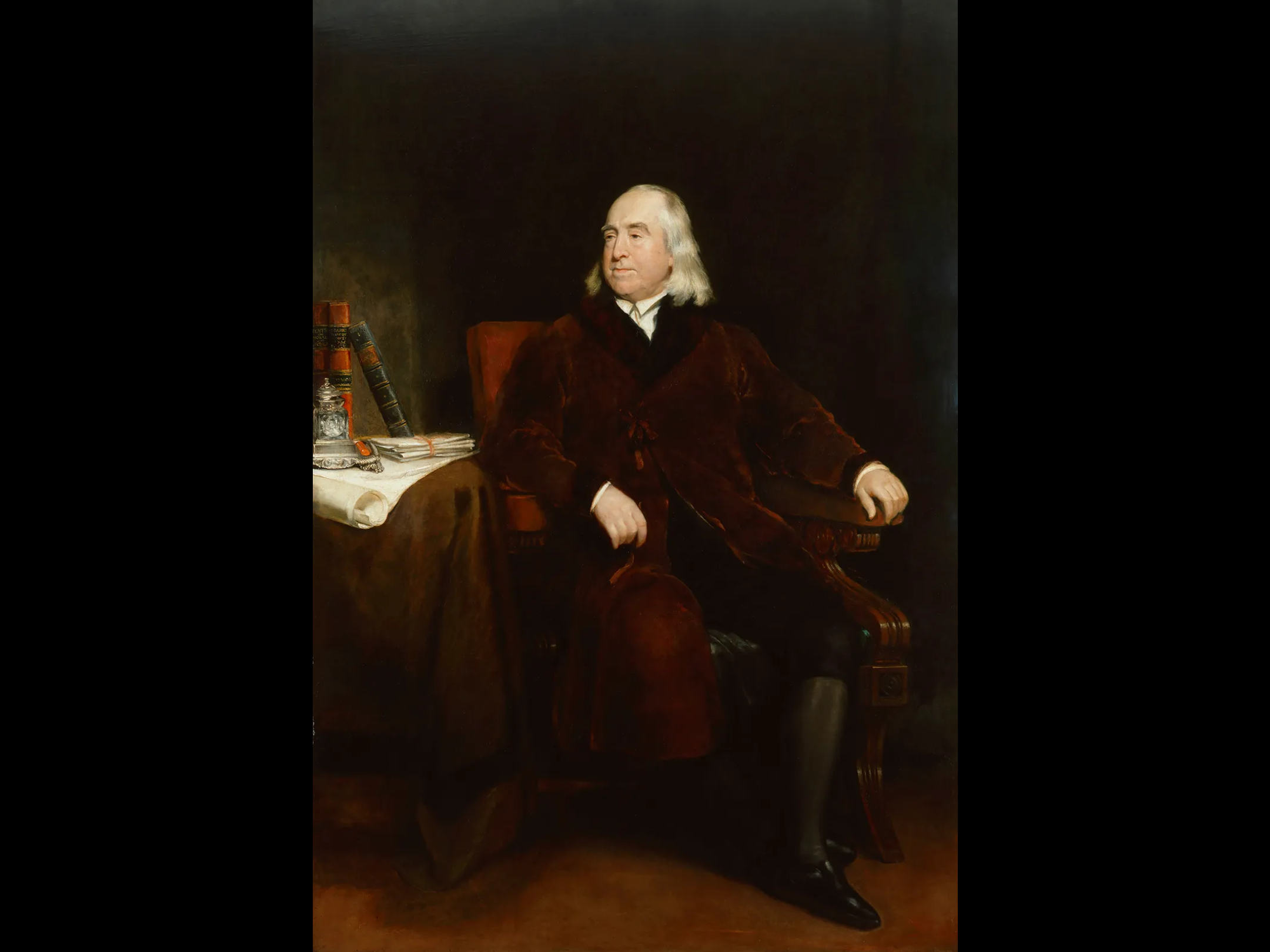
Jeremy Bentham is often reduced to a formula: the greatest happiness of the greatest number. Yet his utilitarianism was not simply a method for solving private moral dilemmas. It was a programme for exposing inherited institutions to public criticism. Laws, prisons, governments and empires had to justify themselves through their consequences for human happiness.1
Utility as a language of reform
Bentham did not invent every element of utilitarian thought. Epicurean ethics, Francis Hutcheson’s moral philosophy, Cesare Beccaria’s penal reform and William Paley’s theological utilitarianism all formed part of the wider genealogy. Bentham’s distinctive contribution was to make utility the organising principle of legislation and institutional design.2

In An Introduction to the Principles of Morals and Legislation, printed in 1780 and first published in 1789, pleasure and pain became the starting points of moral and political analysis. The value of an action depended upon its effects, not its conformity to inherited authority. Government existed to reduce suffering and enlarge well-being.3
The felicific calculus
Bentham’s felicific or hedonic calculus identified seven dimensions through which pleasure and pain could be assessed: intensity, duration, certainty, proximity, fecundity, purity and extent. The scheme did not function as a literal machine that issued an indisputable answer to every problem. Its importance lay in demanding comparison. Legislators should ask who benefits, who suffers, how many people are affected and for how long.4
- Intensity and duration: how powerful and lasting is the pleasure or pain?
- Certainty and proximity: how likely is it, and how soon will it occur?
- Fecundity and purity: will it generate further consequences of the same or opposite kind?
- Extent: how many people will experience the result?
The approach made policy answerable to consequences, but it also created difficulties. Experiences cannot always be measured on a common scale, and a large aggregate benefit might appear to justify serious harm to a minority. Later utilitarians would wrestle with the relationship between happiness, justice and individual rights.
Law, punishment and democratic government
Bentham treated law as a human construction that could be analysed and redesigned. He attacked obscure legal language, disproportionate punishment and institutions protected by tradition rather than usefulness. His projects ranged from prison administration and poor relief to representative government and codification.5
His reformism could be strikingly radical, although its limits require care. He publicly opposed the slave trade, but his treatment of slavery and immediate abolition was not always consistent. In an unpublished 1785 manuscript he argued against criminal sanctions for consensual sex between men, and over time he developed an increasingly democratic account of political accountability.6 Yet the panopticon also demonstrates utilitarianism’s disciplinary side: an institution might claim to improve conduct while making its subjects permanently visible to authority.
Transcribing Bentham
Bentham left an enormous manuscript archive, much of it difficult to read and never published in his lifetime. The UCL Bentham Project is producing the authoritative edition of his collected works, while Transcribe Bentham has invited volunteers to convert manuscript images into searchable, editorially usable text.7

This is more than a technical exercise. Transcription recovers revisions, abandoned schemes and unresolved contradictions that cannot be seen in a small canon of printed books. It reminds the intellectual historian that “Bentham” was not a completed system but a lifetime of writing addressed to changing political circumstances.
Anti-colonial argument and the problem of Australia
Bentham’s relationship with empire is especially revealing. In Emancipate Your Colonies!, addressed to revolutionary France, he argued that colony-holding imposed costs and corruption upon both rulers and ruled.8 He also attacked the penal colony in New South Wales while advancing the panopticon as an alternative system of punishment.9
Opposition to colonial government did not make Bentham free from colonial assumptions. His 1831 “Colonization Company Proposal” supported a free-settler colony in southern Australia. It excluded First Nations Australians from colonial political society and treated their country as saleable “waste land.” The people most affected by colonisation could therefore disappear from a calculation ostensibly concerned with universal happiness.10

This contradiction should not be flattened into the later imperial utilitarianism associated with James and John Stuart Mill. Dr Wallace rightly emphasised that Bentham and the Mills occupied different political contexts and cannot simply be conflated.11 But distinction is not exoneration. It allows us to ask more precisely who counted within Bentham’s universal language and where its limits appeared.
Conclusion
Bentham’s utilitarianism supplied a powerful language for judging law by its human consequences. It inspired reforms in punishment, administration and democratic government, while also encouraging ambitions to observe, classify and manage populations. His writings on empire expose both the critical reach and the exclusions of that project.
The manuscripts matter because they prevent a slogan from standing in for a historical thinker. Transcribing Bentham reveals a reformer whose ideas developed through unfinished arguments, institutional campaigns and encounters with the global politics of his age.
Related Reading
Continue exploring related themes across The Intellectual Historian:
- Beyond the Age of Reason: Constructing the Enlightenment
- Natural Law and Natural Rights: Pufendorf, Sociability and Political Obligation
- Rousseau: Freedom, Inequality and the Problem of Modern Society
Notes
- Philip Schofield, Utility and Democracy: The Political Thought of Jeremy Bentham (Oxford: Oxford University Press, 2006), 1–18. ↩
- Philip Schofield, Bentham: A Guide for the Perplexed (London: Continuum, 2009), chap. 1. ↩
- Jeremy Bentham, An Introduction to the Principles of Morals and Legislation, ed. J. H. Burns and H. L. A. Hart (Oxford: Clarendon Press, 1996), xxxi–lxix, 11–16. ↩
- Bentham, Introduction to the Principles of Morals and Legislation, chap. 4, 38–41. ↩
- Schofield, Bentham: A Guide for the Perplexed, chaps. 3–5. ↩
- Frederick Rosen, “Jeremy Bentham on Slavery and the Slave Trade,” in Utilitarianism and Empire, ed. Bart Schultz and Georgios Varouxakis (Lanham, MD: Lexington Books, 2005), 33–56; Jeremy Bentham, Of Sexual Irregularities, and Other Writings on Sexual Morality, ed. Philip Schofield, Catherine Pease-Watkin, and Michael Quinn (Oxford: Clarendon Press, 2014); Schofield, Utility and Democracy. ↩
- Tim Causer, Justin Tonra, and Valerie Wallace, “Transcription Maximized; Expense Minimized? Crowdsourcing and Editing The Collected Works of Jeremy Bentham,” Literary and Linguistic Computing 27, no. 2 (2012): 119–37. ↩
- Jeremy Bentham, “Emancipate Your Colonies!,” in Rights, Representation, and Reform: Nonsense upon Stilts and Other Writings on the French Revolution, ed. Philip Schofield, Catherine Pease-Watkin, and Cyprian Blamires (Oxford: Clarendon Press, 2002), 289–315. ↩
- Jeremy Bentham, Panopticon versus New South Wales and Other Writings on Australia, ed. Tim Causer and Philip Schofield (London: UCL Press, 2022). ↩
- Zoë Laidlaw, “‘Peopling the Country by Unpeopling It’: Jeremy Bentham’s Silences on Indigenous Australia,” in Jeremy Bentham and Australia: Convicts, Utility and Empire, ed. Tim Causer, Margot Finn, and Philip Schofield (London: UCL Press, 2022), 248–72; Jane Lydon, “‘A Valuable Man’ and ‘One of the Wisest and Best of Mankind’: Jeremy Bentham, Edward Gibbon Wakefield, and Systematic Colonization,” Modern Intellectual History 23, no. 1 (2026): 48–70. ↩
- Jennifer Pitts, A Turn to Empire: The Rise of Imperial Liberalism in Britain and France (Princeton, NJ: Princeton University Press, 2005), 103–62; Schofield, Utility and Democracy. ↩
Selected Bibliography
- Bentham, Jeremy. An Introduction to the Principles of Morals and Legislation. Edited by J. H. Burns and H. L. A. Hart. Oxford: Clarendon Press, 1996.
- ———. Of Sexual Irregularities, and Other Writings on Sexual Morality. Edited by Philip Schofield, Catherine Pease-Watkin, and Michael Quinn. Oxford: Clarendon Press, 2014.
- ———. Panopticon versus New South Wales and Other Writings on Australia. Edited by Tim Causer and Philip Schofield. London: UCL Press, 2022.
- ———. Rights, Representation, and Reform: Nonsense upon Stilts and Other Writings on the French Revolution. Edited by Philip Schofield, Catherine Pease-Watkin, and Cyprian Blamires. Oxford: Clarendon Press, 2002.
- Causer, Tim, Justin Tonra, and Valerie Wallace. “Transcription Maximized; Expense Minimized? Crowdsourcing and Editing The Collected Works of Jeremy Bentham.” Literary and Linguistic Computing 27, no. 2 (2012): 119–37.
- Laidlaw, Zoë. “‘Peopling the Country by Unpeopling It’: Jeremy Bentham’s Silences on Indigenous Australia.” In Jeremy Bentham and Australia: Convicts, Utility and Empire, edited by Tim Causer, Margot Finn, and Philip Schofield, 248–72. London: UCL Press, 2022.
- Lydon, Jane. “‘A Valuable Man’ and ‘One of the Wisest and Best of Mankind’: Jeremy Bentham, Edward Gibbon Wakefield, and Systematic Colonization.” Modern Intellectual History 23, no. 1 (2026): 48–70.
- Mack, Mary P. Jeremy Bentham: An Odyssey of Ideas, 1748–1792. London: Heinemann, 1962.
- Pitts, Jennifer. A Turn to Empire: The Rise of Imperial Liberalism in Britain and France. Princeton, NJ: Princeton University Press, 2005.
- Rosen, Frederick. “Jeremy Bentham on Slavery and the Slave Trade.” In Utilitarianism and Empire, edited by Bart Schultz and Georgios Varouxakis, 33–56. Lanham, MD: Lexington Books, 2005.
- Schofield, Philip. Bentham: A Guide for the Perplexed. London: Continuum, 2009.
- ———. Utility and Democracy: The Political Thought of Jeremy Bentham. Oxford: Oxford University Press, 2006.
Article word count: 858 words
Cite this article
Chicago style: Samuel Woodall, “Jeremy Bentham: Utility, Reform and the Problem of Empire,” The Intellectual Historian, 13 May 2023, https://theintellectualhistorian.com/2023/05/13/jeremy-bentham-transcribing-the-utilitarian-project/.
Leave a Reply