
This essay grew from MLitt work completed under the supervision of Professor John Robertson at the University of St Andrews.
The Enlightenment is often presented as Europe’s triumphant “Age of Reason”: a unified movement that replaced superstition with science and prepared the way for modern liberty. That story is memorable, but it is too smooth. The eighteenth century contained rival Enlightenments, rooted in different cities, institutions, confessions and political projects. The Enlightenment was not a single doctrine. It was a contested argument about improvement, knowledge and authority.1
How was the Enlightenment constructed?
Historians do not encounter a ready-made period labelled “the Enlightenment”. The category was assembled both by eighteenth-century writers and by later interpreters. Twentieth-century scholarship often looked for a coherent philosophical spirit centred on reason, secularisation and progress. Returning to contemporary texts reveals a less orderly landscape.2
As Professor Robertson emphasised, reconstruction begins by asking what historical actors thought they were doing. Some sought religious reform rather than irreligion; others defended commercial society, civic virtue, monarchy or republicanism. Arguments that appear to belong to one movement could lead towards sharply different political conclusions.3
Networks, salons and the public sphere
Social history relocates Enlightenment thought from a gallery of great philosophers into the settings where ideas circulated. The Republic of Letters connected correspondents across borders. Salons, coffee houses, academies, universities, printing shops and Masonic lodges created spaces in which manuscripts, books and reputations moved.

These networks were never wholly open. Participation depended upon education, wealth, gender, status and access to print. Women could exercise considerable influence as salonnières, writers and correspondents while remaining excluded from many formal institutions. The “public sphere” was therefore both an expansion of discussion and a structure of social distinction.4
The Encyclopédie and the order of knowledge
Denis Diderot and Jean le Rond d’Alembert’s Encyclopédie, published across the middle decades of the eighteenth century, was not simply a warehouse of facts. Its tree of knowledge rearranged relationships among memory, reason and imagination. Cross-references allowed apparently technical articles to unsettle religious, political and intellectual authority.5
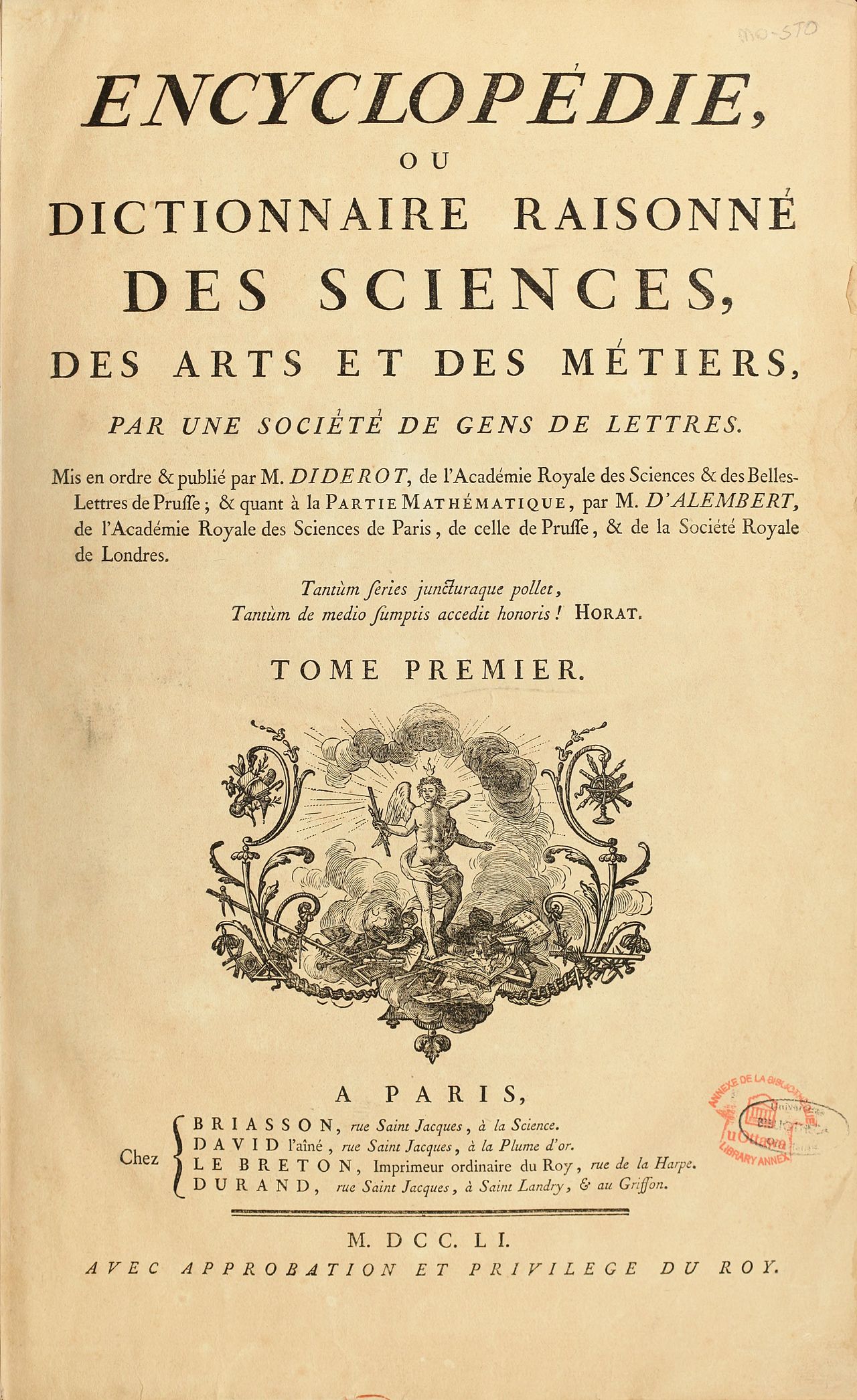
The project was collaborative, commercial and politically vulnerable. Contributors did not share a single philosophy. Rousseau wrote important articles on music, yet his Discourse on the Sciences and Arts challenged the confidence that expanding knowledge necessarily improved morals. He was not outside the Enlightenment so much as evidence of its internal argument.6

Reason without a single philosophy
Ernst Cassirer’s Philosophy of the Enlightenment sought unity in a shared critical method rather than an agreed catalogue of beliefs. Reason was active: it examined inherited systems and extended inquiry into nature, morality and society. Cassirer’s interpretation remains powerful because it takes the century’s intellectual ambitions seriously.7
Yet unity can become misleading. Enlightenment writers disagreed over empire, slavery, commerce, religion, gender and political authority. Kant placed limits around reason even while defining enlightenment as release from self-incurred immaturity. Rousseau suspected that refinement could deepen dependence. Religious thinkers used criticism to defend reformed Christianity rather than abandon faith.8
Reform, utopia and revolution
Franco Venturi reconstructed the Enlightenment through movements of reform and political communication across Europe. His work resisted treating the French Revolution as the inevitable fulfilment of philosophy. Eighteenth-century projects ranged from administrative reform and religious toleration to republican experimentation and utopian reconstruction.9
The Revolution transformed how the preceding century was remembered. Counter-revolutionary writers such as Augustin Barruel claimed that philosophes and secret societies had conspired to destroy the old order. Admirers told an inverted version in which reason naturally culminated in liberty. Both narratives imposed coherence backwards upon writers who could not have foreseen 1789.10
Modernity and the danger of hindsight
The Enlightenment is frequently made responsible for modernity itself – liberal democracy and human rights on one account, empire, instrumental reason or totalitarianism on another. These genealogies can identify genuine inheritances, but they become proleptic when later outcomes are treated as the intentions of eighteenth-century authors.
Intellectual history should trace reception without confusing it with origin. Ideas travel, acquire new purposes and become weapons in controversies their authors never knew. The task is not to deny long-term consequences, but to explain the stages through which those consequences were produced.
Conclusion
There was no single Enlightenment hidden behind the bright lights of reason. There were overlapping projects of criticism, sociability, classification, religious reform and political improvement. Their participants disagreed about the meaning of progress and the people entitled to share in it.
That complexity does not make the Enlightenment meaningless. It makes it historical. By reconstructing its arguments rather than celebrating or prosecuting an abstract “Age of Reason”, we can understand how modern claims about knowledge and freedom were created, contested and transformed.
READ · LISTEN · DISCUSS
Enlightenment, natural law and toleration
Notes
- Dorinda Outram, The Enlightenment, 4th ed. (Cambridge: Cambridge University Press, 2019), 1–14; John Robertson, The Case for the Enlightenment: Scotland and Naples, 1680–1760 (Cambridge: Cambridge University Press, 2005), 1–51. ↩
- Dan Edelstein, The Enlightenment: A Genealogy (Chicago: University of Chicago Press, 2010), 1–19. ↩
- Robertson, Case for the Enlightenment, 1–51. ↩
- Outram, Enlightenment, 45–64. ↩
- Jean Le Rond d’Alembert, Preliminary Discourse to the Encyclopedia of Diderot, trans. Richard N. Schwab with Walter E. Rex (Chicago: University of Chicago Press, 1995), pt. 1. ↩
- Jean-Jacques Rousseau, “Discourse on the Sciences and Arts,” in The Discourses and Other Early Political Writings, ed. and trans. Victor Gourevitch (Cambridge: Cambridge University Press, 1997), 1–28. ↩
- Ernst Cassirer, The Philosophy of the Enlightenment, trans. Fritz C. A. Koelln and James P. Pettegrove (Princeton, NJ: Princeton University Press, 1951), 3–36. ↩
- Immanuel Kant, “An Answer to the Question: What Is Enlightenment?,” in Practical Philosophy, ed. and trans. Mary J. Gregor (Cambridge: Cambridge University Press, 1996), 11–22; Rousseau, “Discourse on the Sciences and Arts,” 1–28; Robertson, Case for the Enlightenment, 1–51. ↩
- Franco Venturi, Utopia and Reform in the Enlightenment (Cambridge: Cambridge University Press, 1971), 1–21. ↩
- Augustin Barruel, Memoirs Illustrating the History of Jacobinism, trans. Robert Clifford, 4 vols. (London: T. Burton, 1797–98), vol. 1, preliminary discourse and pts. 1–2; Edelstein, Enlightenment, 1–19. ↩
Bibliography
- Barruel, Augustin. Memoirs Illustrating the History of Jacobinism. Translated by Robert Clifford. 4 vols. London: T. Burton, 1797–98.
- Cassirer, Ernst. The Philosophy of the Enlightenment. Translated by Fritz C. A. Koelln and James P. Pettegrove. Princeton, NJ: Princeton University Press, 1951.
- d’Alembert, Jean Le Rond. Preliminary Discourse to the Encyclopedia of Diderot. Translated by Richard N. Schwab with Walter E. Rex. Chicago: University of Chicago Press, 1995.
- Edelstein, Dan. The Enlightenment: A Genealogy. Chicago: University of Chicago Press, 2010.
- Kant, Immanuel. “An Answer to the Question: What Is Enlightenment?” In Practical Philosophy, edited and translated by Mary J. Gregor, 11–22. Cambridge: Cambridge University Press, 1996.
- Outram, Dorinda. The Enlightenment. 4th ed. Cambridge: Cambridge University Press, 2019.
- Robertson, John. The Case for the Enlightenment: Scotland and Naples, 1680–1760. Cambridge: Cambridge University Press, 2005.
- Rousseau, Jean-Jacques. The Discourses and Other Early Political Writings. Edited and translated by Victor Gourevitch. Cambridge: Cambridge University Press, 1997.
- Venturi, Franco. Utopia and Reform in the Enlightenment. Cambridge: Cambridge University Press, 1971.
Article word count: 815 words
Cite this article
Chicago style: Samuel Woodall, “Beyond the Age of Reason: Constructing the Enlightenment,” The Intellectual Historian, 23 March 2023, https://theintellectualhistorian.com/2023/03/23/beyond-the-bright-lights-examining-the-complexity-and-construction-of-the-enlightenment/.
Leave a Reply