
This essay grew from MLitt work completed under the supervision of Dr Bill Jenkins at the University of St Andrews.
Charles Darwin’s theory did not appear in an intellectual vacuum. When he studied medicine at Edinburgh in the 1820s, the city already contained lively disputes about species, geology, anatomy and the history of life. Lamarckian transmutation was only one possibility among many, but Edinburgh exposed Darwin to a culture in which the natural world could be imagined as dynamic rather than fixed.1
The Plinian Society and student science
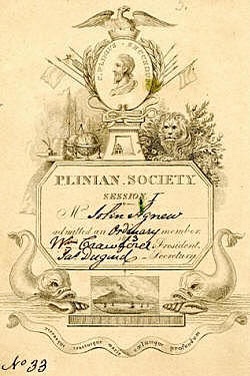
The student-run Plinian Natural History Society first met in January 1823 as a forum for papers, specimens and argument. Its meetings ranged across botany, zoology, geology and anatomy. Robert Jameson, Regius Professor of Natural History, was an honorary member and institutional patron; sources differ over whether he should be described as its founder. Younger naturalists used the society to test ideas that could be too speculative for formal teaching.2

An anonymous discussion of transformist ideas published in Jameson’s Edinburgh New Philosophical Journal in 1826 has often been attributed to Jameson himself. Recent authorship analysis by Pietro Corsi has challenged confident attribution and reconstructed the editorial and translation networks through which continental evolutionary writing entered British journals. The uncertainty is revealing: evolutionary ideas circulated through reviews, translations and editorial networks, not simply through the declarations of isolated scientific heroes.3
What did Lamarckism mean?
Jean-Baptiste Lamarck argued that species were not permanently fixed. Organisms changed over time in response to their circumstances, and acquired modifications could be transmitted across generations. Although later summaries often reduce Lamarckism to a single mechanism, its importance in the early nineteenth century was broader. It made transformation thinkable and offered a natural history governed by development.4
Edinburgh naturalists did not divide neatly into Lamarckians and their opponents. Georges Cuvier’s comparative anatomy and catastrophism, Étienne Geoffroy Saint-Hilaire’s search for underlying anatomical unity, natural theology and materialist physiology all competed and overlapped. Robert Edmond Grant combined detailed work on marine invertebrates with enthusiasm for transmutation. Debate concerned not only whether species changed, but what counted as life, organisation and lawful explanation.5
Geology and the discovery of deep time
Evolutionary speculation depended upon a transformed sense of the Earth’s history. Abraham Gottlob Werner’s Neptunism explained rock formations through precipitation from a primordial ocean and inspired the Wernerian Natural History Society, founded in Edinburgh in 1808. James Hutton offered a different vision: processes observable in the present had operated over immense periods, making the Earth far older than conventional chronologies allowed.6

These were not merely technical disagreements about rocks. Competing geologies reorganised the relationship between scripture, natural law and historical explanation. Once nature acquired a deep history, living forms could also be placed within processes of change that exceeded recorded human time.
Vitalism, materialism and anatomy
Disputes about evolution intersected with arguments over the nature of life itself. Vitalists maintained that living organisms possessed principles that could not be reduced to chemistry and mechanics. Materialists sought explanations within physical organisation. Neither camp mapped perfectly onto a simple opposition between religion and atheism; naturalists could combine theological commitments with experimental anatomy in different ways.7
Robert Knox carried comparative anatomical methods encountered in Paris back to Edinburgh. His reputation was damaged after William Burke and William Hare murdered people and sold their bodies to his anatomy school; how much Knox knew remains disputed. His later racial theorising shows how comparative anatomy could be recruited into hierarchical accounts of human difference. Scientific innovation, commercial anatomy and ethical transgression belonged to the same institutional world.8

Darwin’s Edinburgh education
Darwin arrived in Edinburgh in 1825 and found medical study uncongenial, but his informal scientific education was decisive. Elected to the Plinian Society in November 1826, he collected marine organisms, worked closely with Grant and presented two observations on shore animals in March 1827. These activities taught him to observe, dissect and argue within a community already discussing transformation and common organisation.9
It would be too strong to claim that Darwin simply acquired his later theory in Edinburgh. Natural selection emerged much later through encounters with geology, biogeography, breeding and political economy. Nevertheless, Edinburgh supplied questions and practices that remained important: variation, adaptation, the relationship between environment and organism, and the possibility that species possessed histories.10
Darwin later played down some of these radical associations. Robert Chambers’s anonymously published Vestiges of the Natural History of Creation demonstrated the reputational risks surrounding evolutionary speculation. Darwin’s sustained work on barnacles from 1846 to 1854 helped establish the specialist authority that Vestiges had lacked.11
Religion, institutions and unorthodox ideas
Edinburgh’s fertility did not result from unrestricted freedom. University patronage, the Church of Scotland and later Free Church controversy shaped appointments and the boundaries of respectable inquiry. Natural theology could support scientific study by treating nature as divine design, while transmutation threatened established accounts of providence and humanity’s place in creation.12

Constraint could itself stimulate debate. Ideas crossed institutional boundaries through student societies, journals, museums, lectures and personal rivalries. Edinburgh became influential not because it spoke with one scientific voice, but because incompatible accounts of life and history encountered one another there.
Conclusion
The Edinburgh background complicates any story in which Darwin single-handedly invented evolutionary thought. Lamarck, Jameson, Grant, Hutton, Knox and student naturalists had already made species, organisation and geological time subjects of controversy. Darwin’s originality lay partly in transforming questions produced by that earlier world into a new explanatory framework.
Intellectual history restores that crowded setting. It replaces a straight line from Lamarck to Darwin with a field of competing theories, institutions and ambitions. Evolution was not one idea waiting to be discovered, but a problem assembled through decades of argument about the changing natural world.
Related Reading
Continue exploring related themes across The Intellectual Historian:
- Making Nature Historical: Darwin, Revolution and the Politics of Evolution
- Beyond the Age of Reason: Constructing the Enlightenment
- R. A. Fisher, Statistics and the Political History of Eugenics
Notes
- Janet Browne, Charles Darwin: Voyaging (New York: Alfred A. Knopf, 1995), 64–91. ↩
- J. H. Ashworth, “Charles Darwin as a Student in Edinburgh, 1825–1827,” Proceedings of the Royal Society of Edinburgh 55 (1935): 97–113; Bill Jenkins, Evolution before Darwin: Theories of the Transmutation of Species in Edinburgh, 1804–1834 (Edinburgh: Edinburgh University Press, 2019). ↩
- Pietro Corsi, “Edinburgh Lamarckians? The Authorship of Three Anonymous Papers (1826–1829),” Journal of the History of Biology 54, no. 3 (2021): 345–74. ↩
- Pietro Corsi, The Age of Lamarck: Evolutionary Theories in France, 1790–1830 (Berkeley: University of California Press, 1988). ↩
- Jenkins, Evolution before Darwin; Adrian Desmond, The Politics of Evolution: Morphology, Medicine, and Reform in Radical London (Chicago: University of Chicago Press, 1989), 3–50. ↩
- Bill Jenkins, “Neptunism and Transformism: Robert Jameson and Other Evolutionary Theorists in Early Nineteenth-Century Scotland,” Journal of the History of Biology 49 (2016): 527–57; Martin J. S. Rudwick, Bursting the Limits of Time: The Reconstruction of Geohistory in the Age of Revolution (Chicago: University of Chicago Press, 2005), 445–514. ↩
- Philip F. Rehbock, The Philosophical Naturalists: Themes in Early Nineteenth-Century British Biology (Madison: University of Wisconsin Press, 1983), 74–100. ↩
- A. W. Bates, The Anatomy of Robert Knox: Murder, Mad Science and Medical Regulation in Nineteenth-Century Edinburgh (Brighton: Sussex Academic Press, 2010); Bill Jenkins, “Race before Darwin: Variation, Adaptation and the Natural History of Man in Post-Enlightenment Edinburgh, 1790–1835,” British Journal for the History of Science 53, no. 3 (2020): 333–50. ↩
- Ashworth, “Charles Darwin as a Student in Edinburgh,” 102–13; Browne, Charles Darwin: Voyaging, 72–91. ↩
- Browne, Charles Darwin: Voyaging, 291–385. ↩
- James A. Secord, Victorian Sensation: The Extraordinary Publication, Reception, and Secret Authorship of Vestiges of the Natural History of Creation (Chicago: University of Chicago Press, 2000); Browne, Charles Darwin: Voyaging, 498–510. ↩
- Jenkins, Evolution before Darwin; Jenkins, “Neptunism and Transformism,” 527–57. ↩
Selected Bibliography
- Ashworth, J. H. “Charles Darwin as a Student in Edinburgh, 1825–1827.” Proceedings of the Royal Society of Edinburgh 55 (1935): 97–113.
- Bates, A. W. The Anatomy of Robert Knox: Murder, Mad Science and Medical Regulation in Nineteenth-Century Edinburgh. Brighton: Sussex Academic Press, 2010.
- Browne, Janet. Charles Darwin: Voyaging. New York: Alfred A. Knopf, 1995.
- Corsi, Pietro. The Age of Lamarck: Evolutionary Theories in France, 1790–1830. Berkeley: University of California Press, 1988.
- ———. “Edinburgh Lamarckians? The Authorship of Three Anonymous Papers (1826–1829).” Journal of the History of Biology 54, no. 3 (2021): 345–74.
- Desmond, Adrian. The Politics of Evolution: Morphology, Medicine, and Reform in Radical London. Chicago: University of Chicago Press, 1989.
- Jenkins, Bill. Evolution before Darwin: Theories of the Transmutation of Species in Edinburgh, 1804–1834. Edinburgh: Edinburgh University Press, 2019.
- ———. “Neptunism and Transformism: Robert Jameson and Other Evolutionary Theorists in Early Nineteenth-Century Scotland.” Journal of the History of Biology 49 (2016): 527–57.
- ———. “Race before Darwin: Variation, Adaptation and the Natural History of Man in Post-Enlightenment Edinburgh, 1790–1835.” British Journal for the History of Science 53, no. 3 (2020): 333–50.
- Rehbock, Philip F. The Philosophical Naturalists: Themes in Early Nineteenth-Century British Biology. Madison: University of Wisconsin Press, 1983.
- Rudwick, Martin J. S. Bursting the Limits of Time: The Reconstruction of Geohistory in the Age of Revolution. Chicago: University of Chicago Press, 2005.
- Secord, James A. Victorian Sensation: The Extraordinary Publication, Reception, and Secret Authorship of Vestiges of the Natural History of Creation. Chicago: University of Chicago Press, 2000.
Article word count: 1004 words
Cite this article
Chicago style: Samuel Woodall, “Edinburgh before Darwin: Lamarckism, Natural History and Evolutionary Debate,” The Intellectual Historian, 26 May 2023, https://theintellectualhistorian.com/2023/05/26/revisiting-the-evolutionary-discourse-the-edinburgh-lamarckians-and-darwinian-perspectives-eiih9-part-2/.
Leave a Reply