
This essay grew from undergraduate work completed under the supervision of Dr Deborah Kent.
R. A. Fisher occupies an uncomfortable place in the history of modern science. His work helped establish mathematical statistics and population genetics, yet he was also a committed advocate of eugenics. These were not two entirely separate parts of his career. The same interest in heredity, variation and population that supported major scientific advances could also be turned into political claims about whose reproduction society should encourage.1
Eugenics as science and politics
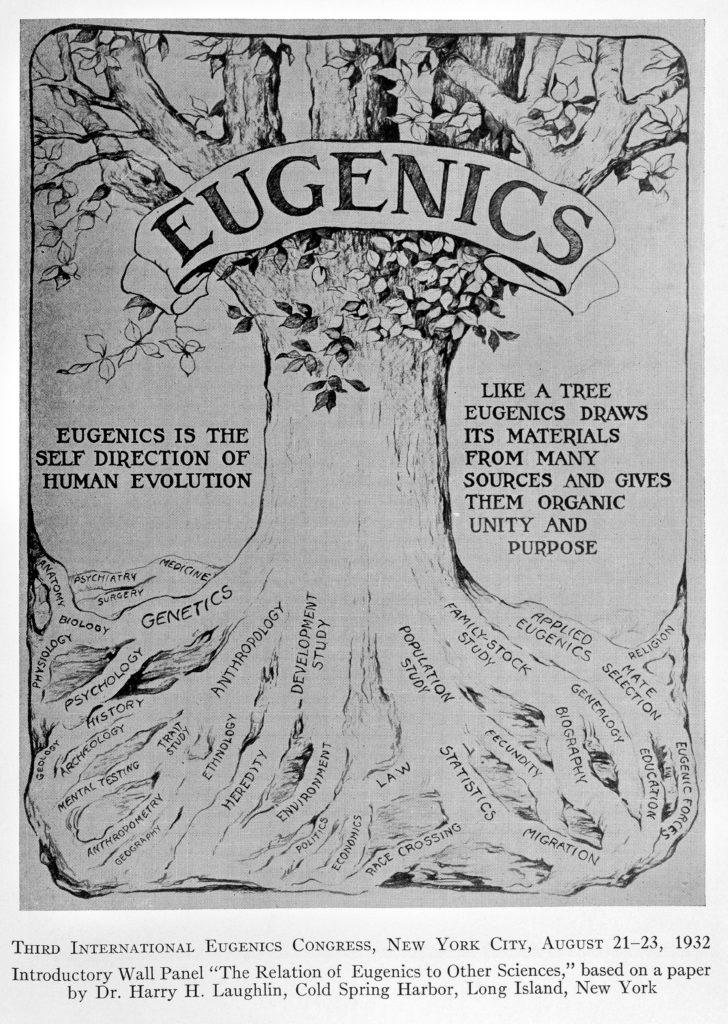
Eugenics emerged in the late nineteenth century from arguments about evolution, heredity, public health and national efficiency. Its advocates claimed that modern societies were weakening natural selection by allowing people they considered “unfit” to survive and reproduce. The language appeared scientific, but its categories reflected assumptions about class, disability, race, gender and social worth.
There was no single eugenic programme. Measures described as “negative” eugenics sought to prevent reproduction through segregation, marriage restrictions or sterilisation. “Positive” eugenics aimed to encourage those judged desirable to have more children through education, taxation or family allowances. In practice, both approaches depended upon institutions deciding which lives possessed greater value.2

Fisher and the rhetoric of decline
Fisher’s 1926 paper “Eugenics: Can It Solve the Problem of the Decay of Civilizations?” placed eugenics within a larger story of civilisational crisis. He presented it in French to the International Federation of Eugenic Organisations in Paris, at a meeting held in rooms belonging to the League of Red Cross Societies. Fisher invoked the decline of Greece and Rome and argued that differential reproduction threatened modern Britain. The clinical language of population masked a deeply political hierarchy: educated and professional families appeared as bearers of civilisation, while the fertility of poorer people became a national danger.3

This rhetoric belonged to a period of imperial anxiety, mass democracy and fear of national degeneration. Fisher translated those anxieties into the language of inheritance. His proposed remedy was not simply better medicine or living conditions, but policies that would alter the reproductive balance between social groups. Family allowances should, in his view, remove economic penalties that discouraged the professional classes from having larger families.4
It is important not to explain this politics as an accidental misuse of otherwise neutral research. Fisher’s scientific and social arguments shared concepts, techniques and institutions. That connection does not invalidate statistical analysis, but it does require historians to examine how research questions were selected and how biological description became social prescription.5
Statistics, genetics and authority
The rediscovery of Gregor Mendel’s work encouraged attempts to connect discrete inheritance with Darwinian natural selection. Fisher’s mathematical methods became central to that synthesis. Statistical techniques made variation measurable and helped researchers evaluate relationships that could not be understood from individual cases alone.6
The authority of quantification was also politically powerful. Once social differences were converted into variables, correlations could be presented as natural facts even when the categories being measured were historically produced. Class position, intelligence, health and family life were treated as inherited characteristics more readily than as outcomes shaped by poverty, education and environment.7
Eugenics therefore reveals a broader danger in the movement between natural and social science. Numbers do not speak independently of the questions, samples and classifications used to produce them. Fisher’s technical achievements were substantial, but the political uses of his expertise formed part of the same intellectual world.
Fisher, Germany and the post-war reckoning
The Nazi state exposed the catastrophic possibilities of racial hygiene, forced sterilisation and human experimentation. Yet the defeat of Nazism did not immediately end every eugenic network or conviction. In 1948 Fisher supplied a reference supporting the professional rehabilitation of the German human geneticist Otmar von Verschuer, whose Kaiser Wilhelm institute had been connected to Josef Mengele’s research at Auschwitz. Fisher praised the scientific value of Verschuer’s pre-war work and wrote that, in the same position, he too would have supported Nazi measures claimed to benefit the German “racial stock,” including the elimination of people labelled mentally deficient.8

A professional reference cannot by itself establish agreement with every action or belief of another person. It can, however, demonstrate which relationships an individual maintained and how they responded to evidence about a compromised field. Fisher’s willingness to defend Verschuer and eugenic reasoning after the war belongs within any serious assessment of his public legacy.
Commemoration and institutional memory
The controversy returned in 2020 when Gonville and Caius College removed a stained-glass window commemorating Fisher. Installed in 1989, the design represented a seven-by-seven Latin square, one of the statistical arrangements associated with his work. The College Council decided on removal in June 2020, and the window was taken down and placed in secure storage by 29 July. Critics saw an unqualified honour to a prominent eugenicist; defenders feared that removal reduced a complex scientific career to one set of beliefs.9

The choice is not simply between celebration and erasure. Museums, colleges and universities can relocate, reinterpret and contextualise commemorative objects. But context must do more than append a warning to an unchanged heroic story. It should explain how scientific prestige, institutional power and eugenic politics reinforced one another.
Conclusion
Fisher’s career resists a comforting division between brilliant science and regrettable private prejudice. His statistics and genetics transformed their fields, while his eugenics shaped public arguments about reproduction, class and national decline. Intellectual history helps us hold those facts together without pretending that one cancels the other.
The larger lesson concerns scientific authority. Methods can remain valuable even when the political programmes attached to them are indefensible, but institutions must still confront the histories through which that authority was built. Critical remembrance is not hostility to science. It is part of understanding how science operates within society.
Related Reading
Continue exploring related themes across The Intellectual Historian:
- Making Nature Historical: Darwin, Revolution and the Politics of Evolution
- Edinburgh before Darwin: Lamarckism, Natural History and Evolutionary Debate
- Michel Foucault: Power, Knowledge and the Practice of History
Notes
- Daniel J. Kevles, In the Name of Eugenics: Genetics and the Uses of Human Heredity (New York: Alfred A. Knopf, 1985), 3–20, 110–28; Donald MacKenzie, Statistics in Britain, 1865–1930: The Social Construction of Scientific Knowledge (Edinburgh: Edinburgh University Press, 1981), chap. 8. ↩
- Pauline M. H. Mazumdar, Eugenics, Human Genetics and Human Failings: The Eugenics Society, Its Sources and Its Critics in Britain (London: Routledge, 1992), 1–18; Richard A. Soloway, Demography and Degeneration: Eugenics and the Declining Birthrate in Twentieth-Century Britain (Chapel Hill: University of North Carolina Press, 1990), 1–25. ↩
- R. A. Fisher, “Eugenics: Can It Solve the Problem of the Decay of Civilizations?,” Eugenics Review 18, no. 2 (1926): 128–36; Alex Aylward, “R. A. Fisher, Eugenics, and the Campaign for Family Allowances in Interwar Britain,” British Journal for the History of Science 54, no. 4 (2021): 485–505, at 488–92. ↩
- Aylward, “R. A. Fisher,” 492–501. ↩
- Aylward, “R. A. Fisher,” 485–505; MacKenzie, Statistics in Britain, chap. 8. ↩
- R. A. Fisher, The Genetical Theory of Natural Selection (Oxford: Clarendon Press, 1930); MacKenzie, Statistics in Britain, chap. 8. ↩
- Mazumdar, Eugenics, Human Genetics and Human Failings, chap. 3; MacKenzie, Statistics in Britain, chap. 8. ↩
- Sheila Faith Weiss, “After the Fall: Political Whitewashing, Professional Posturing, and Personal Refashioning in the Postwar Career of Otmar Freiherr von Verschuer,” Isis 101, no. 4 (2010): 722–58, at 745; Alex Aylward et al., “Eugenics and the Genetics Society,” Heredity 135 (2026): 301–12, at 306–7. ↩
- A. W. F. Edwards, “Statisticians in Stained Glass Houses,” Significance 3, no. 4 (2006): 182–83; Gonville and Caius College, “Fisher Window Removed and Diversity Progress,” July 29, 2020. ↩
Selected Bibliography
- Aylward, Alex. “R. A. Fisher, Eugenics, and the Campaign for Family Allowances in Interwar Britain.” British Journal for the History of Science 54, no. 4 (2021): 485–505.
- Aylward, Alex, Daniel J. Fairbanks, Maria Kiladi, and Gregory Radick. “Eugenics and the Genetics Society.” Heredity 135 (2026): 301–12.
- Edwards, A. W. F. “Statisticians in Stained Glass Houses.” Significance 3, no. 4 (2006): 182–83.
- Fisher, R. A. “Eugenics: Can It Solve the Problem of the Decay of Civilizations?” Eugenics Review 18, no. 2 (1926): 128–36.
- ———. The Genetical Theory of Natural Selection. Oxford: Clarendon Press, 1930.
- Gonville and Caius College. “Fisher Window Removed and Diversity Progress.” July 29, 2020.
- Kevles, Daniel J. In the Name of Eugenics: Genetics and the Uses of Human Heredity. New York: Alfred A. Knopf, 1985.
- MacKenzie, Donald. Statistics in Britain, 1865–1930: The Social Construction of Scientific Knowledge. Edinburgh: Edinburgh University Press, 1981.
- Mazumdar, Pauline M. H. Eugenics, Human Genetics and Human Failings: The Eugenics Society, Its Sources and Its Critics in Britain. London: Routledge, 1992.
- Soloway, Richard A. Demography and Degeneration: Eugenics and the Declining Birthrate in Twentieth-Century Britain. Chapel Hill: University of North Carolina Press, 1990.
- Weiss, Sheila Faith. “After the Fall: Political Whitewashing, Professional Posturing, and Personal Refashioning in the Postwar Career of Otmar Freiherr von Verschuer.” Isis 101, no. 4 (2010): 722–58.
Article word count: 991 words
Cite this article
Chicago style: Samuel Woodall, “R. A. Fisher, Statistics and the Political History of Eugenics,” The Intellectual Historian, 3 January 2024, https://theintellectualhistorian.com/2024/01/03/week-10-an-intellectual-history-of-the-emergence-of-eugenics/.
Leave a Reply