

This essay grew from MLitt work completed under the supervision of Professor Knud Haakonssen at the University of St Andrews.
Natural law is often treated as a direct ancestor of modern human rights. The resemblance is real, but the route between them is neither simple nor inevitable. For seventeenth-century writers such as Samuel Pufendorf, natural law was primarily a language of duties, sociability and political obligation. Recovering that setting prevents later ideas of individual rights from being projected backwards onto a different intellectual world.1
What was natural law?
Natural-law theory asked which moral rules bound human beings independently of the positive laws made by particular governments. Its advocates sought principles accessible through reason and applicable across political communities. Yet those principles were commonly understood within theological, juridical and historical arguments, not as a timeless list of liberal entitlements.
A natural right described a claim or liberty possessed by a person; natural law concerned the rule by which conduct was judged. Rights and duties were connected. My liberty could impose an obligation upon others, while membership in a social order placed limits upon how liberty could be exercised.2
Pufendorf after religious and civil conflict
Samuel von Pufendorf wrote in a Europe shaped by confessional division, the Thirty Years’ War and disputes over sovereignty. His natural jurisprudence sought a moral science capable of explaining obligation without depending upon the institutions of one confession. That did not make his thought secular in the modern sense. God remained the ultimate source of natural law, but human beings could discover its requirements through reason.3
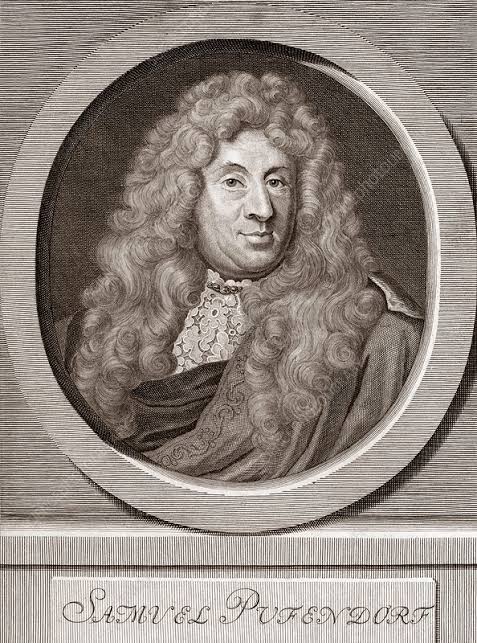
Pufendorf rejected the idea that morality could simply be read from the physical properties of nature. Moral relations arose through imposed statuses and obligations: ruler and subject, parent and child, owner and property-holder. These “moral entities” organised a world in which biological human beings acquired juridical identities.4
Self-preservation and sociability
Human beings were vulnerable, needy and capable of harming one another. Self-preservation therefore pushed them towards society, but sociability was more than calculated convenience. It was the fundamental requirement that people cultivate peaceful life with others in a manner compatible with the shared condition of humanity.5
This position placed Pufendorf in conversation with Thomas Hobbes. Hobbes had made insecurity and the fear of violent death central to political obligation. Pufendorf accepted the seriousness of conflict but resisted reducing social life to fear or self-interest alone. Natural law commanded sociability because isolated individuals could not secure or develop human life.6
Obligation and political authority
For Pufendorf, the state emerged through agreements by which individuals formed a common political person and established a sovereign authority. Political society was artificial rather than natural in the Aristotelian sense, but once established it generated genuine obligations. Government supplied the security within which sociability could operate.7
This did not turn natural law into a straightforward theory of resistance. Early modern jurists were deeply concerned with civil peace, and rights language could support obedience as well as opposition. A ruler’s duties mattered, but the consequences of dissolving authority also entered moral judgment.8
Prudence, history and moral judgment
Universal principles could not determine political action without attention to circumstance. Prudence connected natural law to history: rulers and citizens had to judge character, institutions, danger and likely consequences. The same general duty might demand different actions in different political settings.
This helps explain why natural-law writers were also historians, diplomats and advisers. Moral philosophy did not float above statecraft. It supplied a language through which practical decisions about war, toleration, commerce and sovereignty could be evaluated.9
From natural law to natural rights
Later writers increasingly foregrounded subjective rights possessed by individuals. John Locke’s language of life, liberty and property became especially important to liberal and revolutionary traditions. But the change should not be narrated as the inevitable discovery of modern rights. Duties, corporate bodies, sovereignty and divine command remained central across the period.10
Nor were claims of natural equality consistently extended to everyone. European natural jurisprudence developed alongside empire, slavery and confessional exclusion. Universal language could challenge domination, but it could also coexist with institutions that sharply limited who counted as an independent rights-bearing person.11
Conclusion
Pufendorf’s natural law was a theory of how vulnerable human beings could live together under moral and political authority. Rights formed part of that account, but they were embedded within duties of sociability and historically situated judgments of prudence.
Understanding that difference clarifies both the power and the limits of natural-rights genealogy. Modern rights did not emerge fully formed from seventeenth-century philosophy. They were produced through later arguments that selected, translated and transformed the languages of natural law.
READ · LISTEN · DISCUSS
Natural law, Enlightenment and toleration
- Read further: Beyond the Age of Reason: Constructing the Enlightenment
- Listen: Denis Lacorne: The Limits of Tolerance
- Discuss: Where Should Toleration End?
Notes
- Knud Haakonssen, Natural Law and Moral Philosophy: From Grotius to the Scottish Enlightenment (Cambridge: Cambridge University Press, 1996), 1–12. ↩
- Richard Tuck, Natural Rights Theories: Their Origin and Development (Cambridge: Cambridge University Press, 1979), 1–8, 143–76. ↩
- Samuel Pufendorf, On the Duty of Man and Citizen according to Natural Law, ed. James Tully, trans. Michael Silverthorne (Cambridge: Cambridge University Press, 1991), bk. 1, chs. 2–3; Michael Seidler, “Samuel Freiherr von Pufendorf,” Stanford Encyclopedia of Philosophy, substantive revision 21 August 2026, sections 1 and 3.4, https://plato.stanford.edu/entries/pufendorf/. ↩
- Seidler, “Samuel Freiherr von Pufendorf,” section 3.1. ↩
- Pufendorf, On the Duty of Man and Citizen, bk. 1, ch. 3; Seidler, “Samuel Freiherr von Pufendorf,” sections 3.3–3.4. ↩
- Seidler, “Samuel Freiherr von Pufendorf,” sections 3.3–3.4 and 4.2.1. ↩
- Seidler, “Samuel Freiherr von Pufendorf,” sections 4.2.1–4.2.3. ↩
- Ian Hunter and David Saunders, eds., Natural Law and Civil Sovereignty: Moral Right and State Authority in Early Modern Political Thought (Basingstoke: Palgrave Macmillan, 2002), 1–14; Seidler, “Samuel Freiherr von Pufendorf,” section 4.2. ↩
- Hunter and Saunders, Natural Law and Civil Sovereignty, 1–14. ↩
- Tuck, Natural Rights Theories, 143–76; Haakonssen, Natural Law and Moral Philosophy, 1–12. ↩
- Tuck, Natural Rights Theories, 143–76; J. B. Schneewind, The Invention of Autonomy: A History of Modern Moral Philosophy (Cambridge: Cambridge University Press, 1998), parts 2–3. ↩
Selected Bibliography
- Haakonssen, Knud. Natural Law and Moral Philosophy: From Grotius to the Scottish Enlightenment. Cambridge: Cambridge University Press, 1996.
- Hunter, Ian, and David Saunders, eds. Natural Law and Civil Sovereignty: Moral Right and State Authority in Early Modern Political Thought. Basingstoke: Palgrave Macmillan, 2002.
- Pufendorf, Samuel. On the Duty of Man and Citizen according to Natural Law. Edited by James Tully. Translated by Michael Silverthorne. Cambridge: Cambridge University Press, 1991.
- Schneewind, J. B. The Invention of Autonomy: A History of Modern Moral Philosophy. Cambridge: Cambridge University Press, 1998.
- Seidler, Michael. “Samuel Freiherr von Pufendorf.” Stanford Encyclopedia of Philosophy. Substantive revision 21 August 2026. https://plato.stanford.edu/entries/pufendorf/.
- Tuck, Richard. Natural Rights Theories: Their Origin and Development. Cambridge: Cambridge University Press, 1979.
Article word count: 776 words
Cite this article
Chicago style: Samuel Woodall, “Natural Law and Natural Rights: Pufendorf, Sociability and Political Obligation,” The Intellectual Historian, 14 March 2023, https://theintellectualhistorian.com/2023/03/14/natural-law-and-natural-rights/.
Leave a Reply