
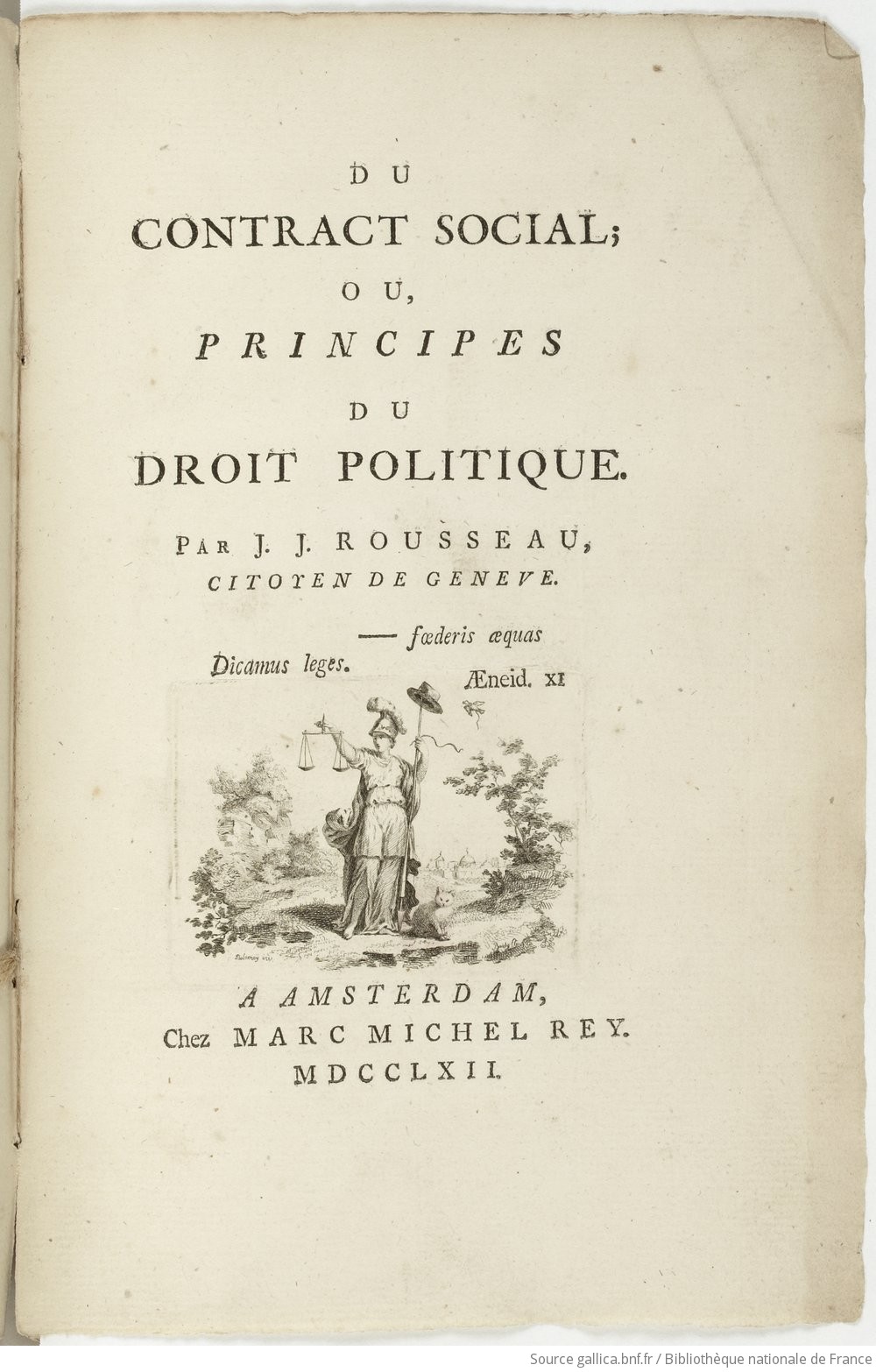
Rousseau: Self, Freedom and Education · Reading companion 2 of 3
Read Rousseau’s account of inequality alongside The Social Contract to examine dependence, citizenship and freedom under law.
Dependence before consent
Rousseau’s Discourse on Inequality asks how social arrangements make some people dependent on others. Its account of property is a philosophical reconstruction, not an archaeological history. It challenges the assumption that familiar inequalities must therefore be natural or legitimate.1
Reading that argument before The Social Contract changes the political question. Agreement alone may be a poor measure of freedom when people possess unequal power to refuse. We need to ask about the conditions under which consent is given, as well as its formal expression.
Freedom within political association
The Social Contract seeks a form of association in which citizens can live under common laws without surrendering themselves to a private master. In I.6-8, Rousseau distinguishes natural liberty from the civil and moral liberty made possible by legitimate association. Political freedom involves membership of a body that makes law, rather than simply escape from restraint.2
The general will concerns the common interest. It cannot be identified without argument with a ruler’s instructions, or with the sum of everyone’s private preferences. Book II’s distinction between the general will and the will of all makes that problem central.2
The problem of dissent
A difficult test follows. If someone disputes a law, does that disagreement reveal private advantage, or a failure to identify the common good? An institution cannot settle the question merely by declaring its own decision to be the people’s true will. The distinction needs political safeguards and conditions for credible judgement.
Our reading should therefore resist both easy praise and easy dismissal. Rousseau offers a demanding account of collective self-government while leaving readers to confront the danger of coercion justified in the language of freedom. The tension is most useful when we ask whose judgement counts and how a citizen can challenge it.
The conditions of a common judgement
Book II, chapter 3 sharpens the distinction between a common interest and an unreliable decision. Rousseau allows that people can be mistaken about what serves them. The claim that the general will concerns the common good therefore does not guarantee that every vote correctly identifies it. Read his concern about partial associations alongside this problem: a group can organise its members around an advantage they share while overlooking the interests of the wider political community.2
This makes inequality relevant to more than the origins of society. If some citizens depend heavily on others, the conditions under which a common judgement is formed deserve scrutiny. A formally shared procedure may conceal very different capacities to speak, refuse or influence the outcome. That observation is a way of testing the argument, rather than a claim that Rousseau provides a complete solution to institutional design. When reading a proposed law, ask three questions: who bears its burdens, whose advantage is presented as universal, and how could a citizen contest that presentation? Those questions connect the text’s promise of collective freedom with its unresolved vulnerability to domination.
The difference between willing a common good and recognising it correctly is therefore essential. It leaves room for error within a theory often reduced to certainty about what the people want. Keeping that distinction in view makes both the attraction and the danger of Rousseau’s political argument easier to assess.
A question to take away
What would distinguish a law serving a common interest from a majority imposing its preferences?
Read alongside us
Discourse on Inequality, Part II, opening account of property; The Social Contract, I.6-8 and II.1-3.
Notes and bibliography
1. Rousseau, Jean-Jacques. Discourse on the Origin and Foundations of Inequality among Men. Part II. In The Social Contract & Discourses. Translated by G. D. H. Cole. London: J. M. Dent & Sons, 1920.
2. Rousseau, Jean-Jacques. The Social Contract. I.6-8; II.1-3. In The Social Contract & Discourses. Translated by G. D. H. Cole. London: J. M. Dent & Sons, 1920. Text.
Read, listen and discuss
Read the longer introduction to Rousseau’s political thought.
Image: Jean-Jacques Rousseau, Du contrat social, title page, 1762. Bibliothèque nationale de France. Public domain, via Wikimedia Commons. Source and image details.

Word count: 549 (main prose, including the discussion question; excluding headings, episode links, reading lists, notes, bibliography, credits and citation).
Cite this article
Woodall, Samuel. “Can We Be Free Under Laws? Rousseau, Inequality and the General Will.” The Intellectual Historian, October 14, 2026. https://theintellectualhistorian.com/?p=2492.
Leave a Reply