
Hobbes: Fear, Power and Faction · Episode 3 of 3 · Complete series
Political disagreement is unavoidable. For Hobbes, the danger begins when competing loyalties acquire enough authority to divide the commonwealth.
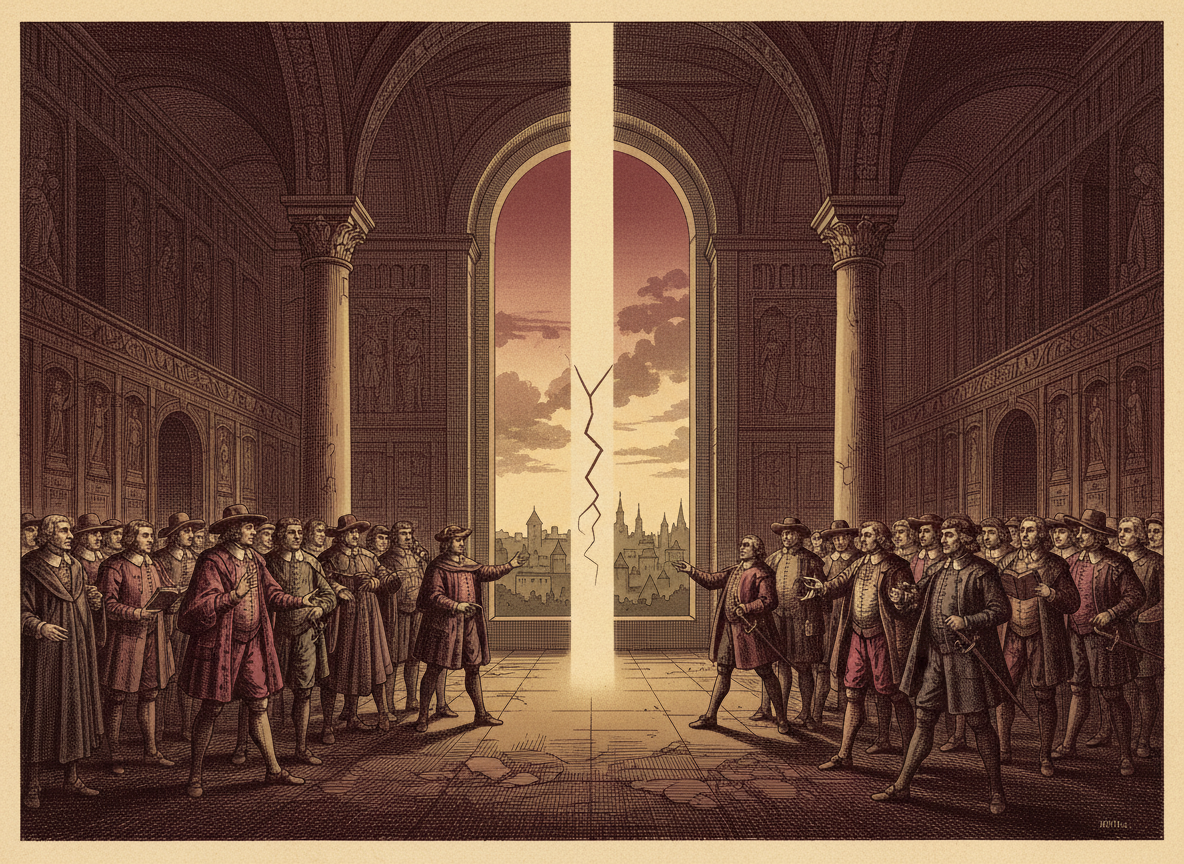
The final episode connects Hobbes directly to the problem of faction. His concern is not simply that citizens hold different opinions, but that religious bodies, political leaders and organised interests may claim an authority capable of rivalling the sovereign. When people no longer recognise a final judge, disagreement can become sedition and the commonwealth can return to the condition of war it was created to escape.
Watch the conversation
In this episode
- The difference between private disagreement and organised faction
- Hobbes’s fear of divided sovereignty and competing authorities
- Religion, political language and the causes of civil conflict
- What Hobbes can contribute to the longer history of party and loyal opposition
How a commonwealth comes apart
The final episode turns to chapter 12 of De Cive. Hobbes asks us to distinguish the dispositions that make people receptive to sedition, the people who organise them, and faction itself. This is a useful distinction because widespread dissatisfaction does not explain, by itself, how collective action takes shape. Arguments, leadership and organisation matter to the movement from unease to political rupture.
Who has the final word?
For Hobbes, conflict becomes especially dangerous when people recognise rival sources of authoritative judgment. A religious teacher, political leader or organised group may claim that its commands deserve obedience over those of the civil power. The dispute is then about more than a particular policy. It concerns who can settle the dispute at all. His resistance to divided sovereignty follows from the fear that competing final authorities cannot remain final together.
Reading Hobbes critically
A modern reader need not accept Hobbes’s answer to take his question seriously. Political societies need ways to distinguish criticism from coercion and opposition from an attempt to replace public authority by force. But treating organised disagreement as inherently destructive risks closing the space in which abuses can be challenged. The useful comparison with later ideas of party and loyal opposition is therefore a question, not a claim that Hobbes already possessed those ideas: under what conditions can an organised opposition help preserve a political community?
A question to take away
How can organised opposition challenge a government while sustaining a shared political order?
Audio chapters
Times refer to the Buzzsprout audio recording. Open the audio chapter navigation.
- 0:00 Welcome And The Faction Question
- 1:20 Disagreement Versus Rival Authority
- 3:50 De Cive And Narrative Control
- 6:50 The Anatomy Of Sedition
- 10:30 The People The Multitude The King
- 13:00 Sovereign Responses And Civil War Risks
- 15:30 Rhetoric Inner Circles And Mobilisation
- 18:10 Liberty Fear And The Water Channel
- 20:00 Glorious Revolution And Your Reply
Read alongside the episode
Hobbes, Thomas. De Cive. Chapter 12, especially sections 1, 8 and 11–13. English translation published as Philosophicall Rudiments Concerning Government and Society, 1651. Read chapter 12.
Further comparison: Hobbes, Thomas. Leviathan. Oxford: Clarendon Press, 1909. First published 1651. Chapter 29. Read on the dissolution of a commonwealth.
Explore the complete trilogy
Episode 1: Who Was Thomas Hobbes and What Was He Afraid Of?
Episode 2: Why Should We Obey the State? Hobbes on Political Obligation
Episode 3: When Does Disagreement Become Faction? Hobbes on Political Division
Word count: 368 words (introduction, episode outline, reading commentary and discussion question).
Cite this article
Samuel Woodall, “When Does Disagreement Become Faction? Hobbes on Political Division,” The Intellectual Historian, October 2, 2026. https://theintellectualhistorian.com/2026/10/02/when-does-disagreement-become-faction-hobbes/.
Leave a Reply