
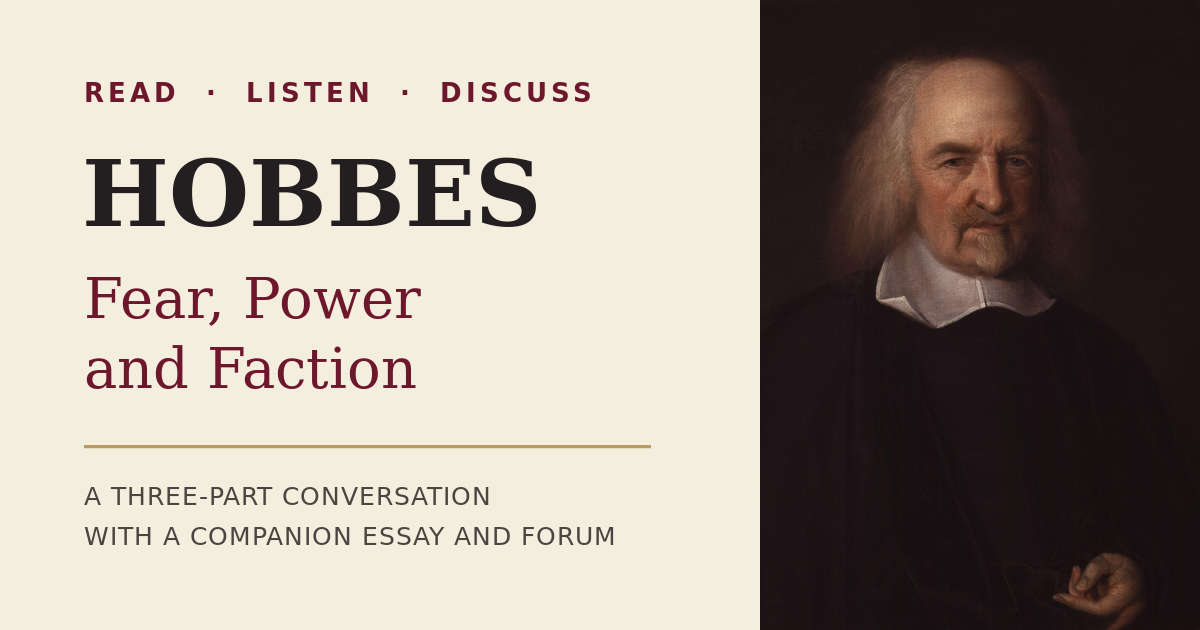
Why does political order begin with fear? Why should anyone obey the state? And when does ordinary disagreement become a threat to political peace?
In this three-part Beyond the Text series, Samuel Woodall and Jack Thomson return to Thomas Hobbes as a thinker formed by civil conflict. Rather than treating Leviathan as an abstract defence of absolute power, the series follows the historical problem that gives Hobbes’s political philosophy its urgency: how can people escape insecurity, establish authority and prevent disagreement from collapsing into faction and civil war?
The complete series
- Who Was Thomas Hobbes and What Was He Afraid Of?
Released 28 September 2026. Hobbes’s life, the experience of political instability and the place of fear in his account of human beings. - Why Should We Obey the State?
Released 30 September 2026. Covenant, authorisation, sovereignty and the grounds of political obligation. - When Does Disagreement Become Faction?
Released 2 October 2026. Division, sedition and Hobbes’s fear that organised disagreement could reopen the path to civil war.
Read alongside the series
Begin with Aubrey’s life of Hobbes and the preface to De Cive for Episode 1, then Hobbes’s Leviathan (1651), especially chapters 13 to 18 on the state of nature, covenant and sovereignty, and chapter 21 on liberty for Episode 2. Episode 3 focuses on De Cive, chapter 12, especially sections 1, 8 and 11–13; Leviathan, chapter 29, offers further comparison.
Listen and watch
All three conversations are now available through Beyond the Text and as an illustrated video on The Intellectual Historian’s YouTube channel. Each companion page above includes its video player, audio link, reading notes and the shared Reading Club discussion.
Leave a Reply