
Hobbes: Fear, Power and Faction · Episode 2 of 3 · Complete series
If political authority is created by human beings, why does it acquire the right to command them?
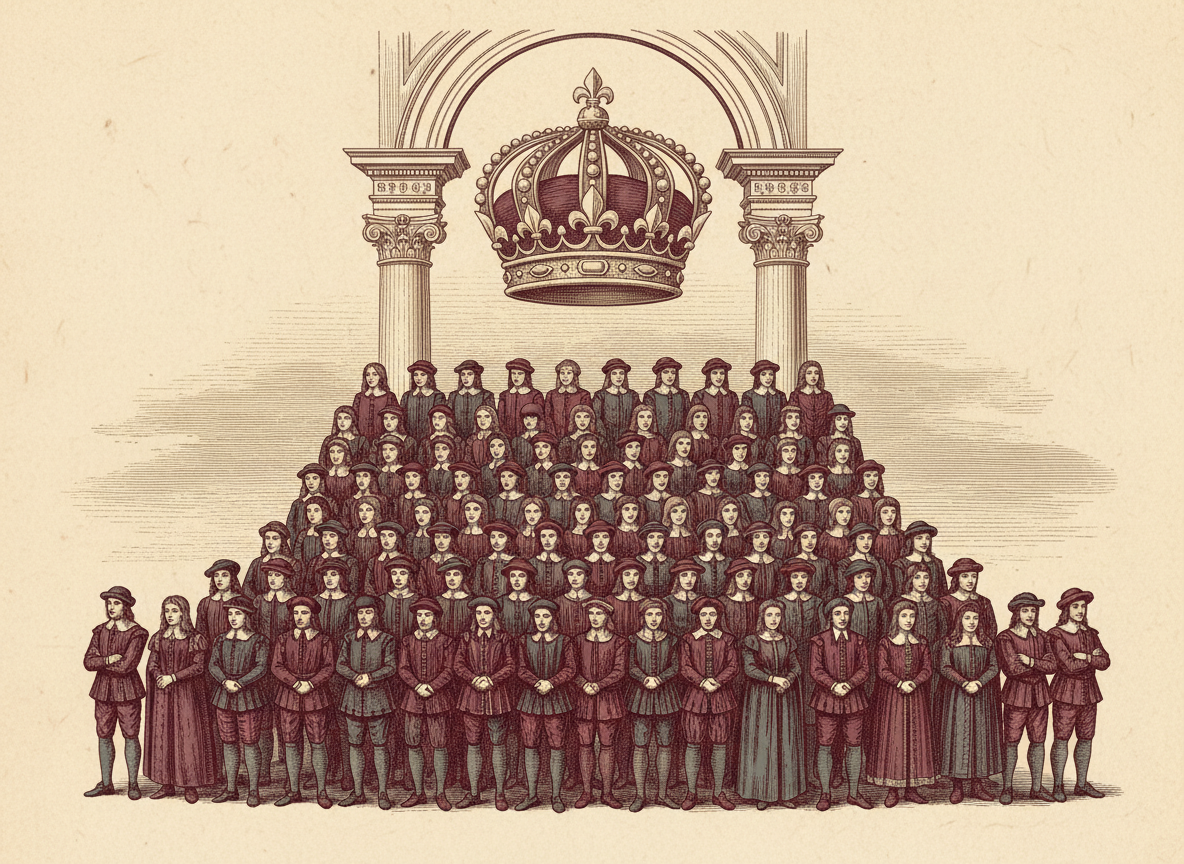
The second episode in our Hobbes trilogy turns from fear to obligation. Hobbes argues that peace requires more than a temporary agreement. Individuals must authorise a sovereign power capable of enforcing covenants and deciding disputes. The commonwealth is therefore an artificial person whose authority is created through the acts of those it governs.
Watch the conversation
In this episode
- Why agreements cannot secure peace without enforcement
- The difference between covenant, consent and authorisation
- Why Hobbes assigns the sovereign such extensive powers
- Whether political obligation is unlimited, and what happens when protection fails
Why a promise is not enough
An agreement to live peacefully has an obvious appeal. Its weakness is that each person must decide whether the others will keep it. If performing first leaves someone exposed, suspicion can defeat cooperation even when everyone would benefit from it. Hobbes’s case for government begins with this problem of assurance. Political power changes the calculation by making breaches of agreement costly and by providing a public means of resolving disputes.
Making a commonwealth
In chapter 17 of Leviathan, the creation of a common power involves authorisation. A multitude becomes politically united through a representative whose actions count as its actions. This is more demanding than a loose alliance between individuals. It gives Hobbes a way to explain how a political community can act as one, but also raises a difficult question: how much authority have people given away when they recognise that representative?
Protection, liberty and obedience
Chapter 21 makes the argument more complicated than a simple exchange of all freedom for security. Hobbes describes liberty as the absence of external impediments and allows subjects room to act where law is silent. He also connects obligation to the sovereign’s capacity to protect. Self-preservation therefore remains central, even within a theory of extensive sovereign authority. These qualifications should not be mistaken for modern constitutional checks. They invite us to ask how far protection can justify obedience, and what follows when protection fails.
A question to take away
What would make political protection sufficient to justify obedience?
Audio chapters
Times refer to the Buzzsprout audio recording. Open the audio chapter navigation.
- 0:00 Welcome And Big Question Of Obedience
- 0:28 The Assurance Problem Without Authority
- 1:18 Hobbes’s State Of Nature Explained
- 3:30 Equality And Three Causes Of Conflict
- 5:18 Glory, Humiliation And Recognition
- 8:50 Two Laws Of Nature For Peace
- 11:20 Why The Sovereign Avoids The Covenant
- 14:15 Liberty, Silent Law And Protection
- 17:16 Morality As Construction And Next Steps
Read alongside the episode
Hobbes, Thomas. Leviathan. 1651. Part I, chapters 13–14; Part II, chapters 17 and 21. Read online at Project Gutenberg.
Explore the complete trilogy
Episode 1: Who Was Thomas Hobbes and What Was He Afraid Of?
Episode 2: Why Should We Obey the State? Hobbes on Political Obligation
Episode 3: When Does Disagreement Become Faction? Hobbes on Political Division
Word count: 349 words (introduction, episode outline, reading commentary and discussion question).
Cite this article
Samuel Woodall, “Why Should We Obey the State? Hobbes on Political Obligation,” The Intellectual Historian, September 30, 2026. https://theintellectualhistorian.com/2026/09/30/why-should-we-obey-the-state-hobbes/.
Leave a Reply