
Hobbes: Fear, Power and Faction · Episode 1 of 3 · Complete series
The first episode in our Hobbes trilogy asks how a life overshadowed by instability shaped one of the most powerful arguments for political order in the history of ideas.
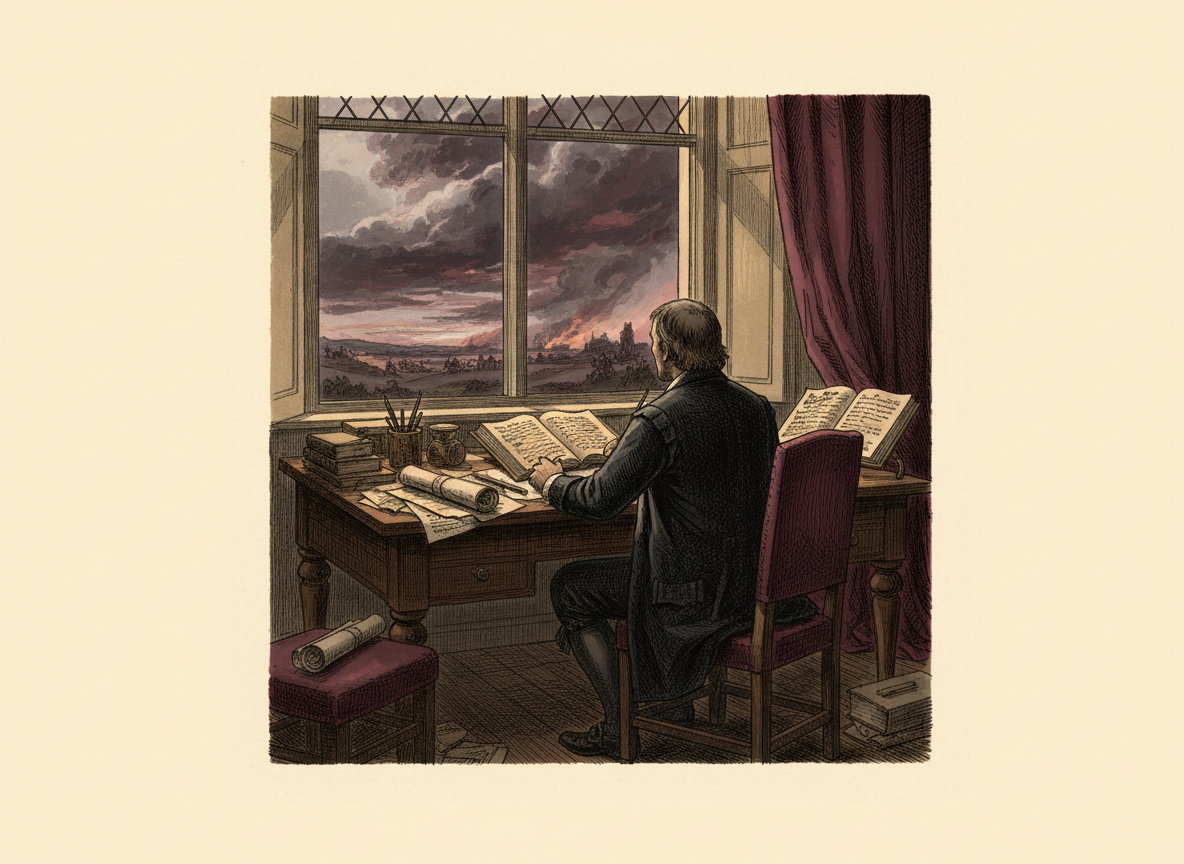
Thomas Hobbes was born in 1588, the year of the Spanish Armada, and later joked that fear was his twin. His mature political philosophy emerged from a Europe marked by religious conflict and from the crisis of the English Civil Wars. In Leviathan (1651), fear is not merely a private emotion. It becomes a force capable of driving people both into conflict and towards the creation of a common authority.
Watch the conversation
In this episode
- Hobbes’s life and the political crises through which he lived
- The state of nature and the fear of violent death
- Why insecurity is social and political, not simply psychological
- How fear can make cooperation and political authority possible
Fear as a political problem
Hobbes’s reputation can make his philosophy seem like a confession of personal pessimism. Yet the opening question is larger than whether he was a fearful man. What happens when people cannot rely on a common authority to protect them? Even someone who would prefer a peaceful life must consider what others might do. Anticipation, suspicion and the search for safety can make conflict intelligible without making it desirable.
Read a life alongside an argument
The episode pairs John Aubrey’s account of Hobbes with the author’s preface to De Cive. These are different kinds of evidence. Aubrey offers a portrait of a person, with habits, relationships and a remembered life. Hobbes’s preface explains how he wants his political argument to be approached. Reading them together helps us connect an intellectual life with its historical setting while resisting the temptation to explain every philosophical claim through a biographical anecdote.
From insecurity to common authority
The important transition is from vulnerability to political construction. Fear can separate people, but the wish to avoid violent death also gives them a reason to seek peace. The difficult question is how that shared wish becomes a durable arrangement. An agreement must do more than express good intentions: it must change what people can reasonably expect of one another. That problem carries the series into the second conversation on covenant and sovereignty.
Vulnerability and the search for peace
Imagine two neighbours who both prefer security to confrontation. Without a trusted way of settling a dispute, each must consider whether the other will act first. A defensive preparation can then look like a threat, prompting further preparation in response. The example illustrates a problem of expectations rather than a claim that every person enjoys violence. It also shows why describing people as either naturally good or naturally wicked can obscure the structure of Hobbes’s question.
Chapter 13 of Leviathan places competition, distrust and glory within this account of conflict. The desire for safety does not remove the desire for advantage or recognition. Different motives can lead towards the same unstable result. When reading the chapter, distinguish the reasons someone might attack from the conditions that make attack seem possible or necessary.
That distinction helps connect the biography to the political argument without collapsing one into the other. Civil conflict gives urgency to the need for a public authority, but an anecdote about Hobbes’s temperament cannot prove his conclusion. The reader must still ask whether the proposed remedy addresses the problem it identifies. What kind of power would make assurances credible, and what new risks would that power introduce? These questions carry fear into an argument about institutions. They explain why the next episode examines authorisation, enforcement and the continuing relationship between protection and obedience.
A question to take away
Can fear lead people towards cooperation as well as conflict?
Audio chapters
Times refer to the Buzzsprout audio recording. Open the audio chapter navigation.
- 0:00 Welcome Back And New Format
- 1:13 Who Was Hobbes And Why Fear
- 4:12 Oxford, Languages, And Patronage
- 8:09 Travel, Geometry, And Thucydides
- 10:54 1640 Crisis And Exile To Paris
- 12:58 Sovereignty And Political Backlash
- 15:12 Civil War Catastrophe And Authority
- 17:28 Realism, Covenants, And Peace
- 19:03 Fear, Liberty, And The Commonwealth
- 22:10 What We Read Next
Read alongside the episode
Aubrey, John. “Thomas Hobbes of Malmesbury.” In Brief Lives, edited by Andrew Clark, vol. 1. Oxford: Clarendon Press, 1898. Read online.
Hobbes, Thomas. De Cive. Author’s Preface. English translation published as Philosophicall Rudiments Concerning Government and Society, 1651. Read the preface.
Further reading: Skinner, Quentin. Hobbes and Republican Liberty. Cambridge: Cambridge University Press, 2008.
Explore the complete trilogy
Episode 1: Who Was Thomas Hobbes and What Was He Afraid Of?
Episode 2: Why Should We Obey the State? Hobbes on Political Obligation
Episode 3: When Does Disagreement Become Faction? Hobbes on Political Division
Word count: 548 (main prose, including the discussion question; excluding headings, episode outline, recording links, chapters, bibliography and citation).
Cite this article
Samuel Woodall, “Who Was Thomas Hobbes and What Was He Afraid Of?,” The Intellectual Historian, September 28, 2026. https://theintellectualhistorian.com/2026/09/28/who-was-thomas-hobbes-what-was-he-afraid-of/.
Leave a Reply