
Acknowledgement of Supervision: Dr Karie Schultz
The medieval period with its rediscovery of the ancients facilitated the rise of political science, synthesised with religious thought. This move can be seen as echoing through to the Reformation, the epoch of this week’s study. During the Reformation, we may observe trends across the realm of ideas and thought, such as resistance and obedience, reactions to particular contexts, scriptural texts and precedents, notions of tyranny, and the interaction between the ‘religious’, ‘political’ and ‘constitutional’. I shall proceed through these in the order as laid out.
Magisterial Reformers:
First of all, ‘resistance theory’ began to emerge. This is a concept that focuses on how and by what means constituted authority may be resisted (and of course by whom and against whom). It was first used to justify civil disobedience on religious grounds, towards monarchs in the post-Reformation period. Later Protestant memory made Luther’s posting of the Ninety-five Theses at Wittenberg in 1517 into an emblem of resistance, although whether he actually nailed them to the church door remains disputed and the theses were initially framed for academic disputation. Furthermore, the paradigmatic shift of ‘natural law’ through the writings and methodologies of St. Thomas Aquinas, predicate the early modern iteration of resistance theory, that what is right can be observed in the natural order and thereby catalyse resistance against what is wrong and unjust. If we are to be fleetingly proleptic, we can see a morphology through from these early versions of ‘resistance theory’ to the ‘right to resist’ that we have enshrined in human rights legislation today – determine how far our civil obedience should persist. However, resistance was not a universally applicable feature in this early modern time. Predominantly, it was solely the ‘magistrates’ who were the temporal rulers and agents of God, who were viewed as those deemed viable to resist. It would be through these “Magisterial Reformers” that religious change would come and they would serve to revitalise Christian society. This stratum is required to mitigate the chance of lawless disorder and antinomianism. 1
Radical Reformers:
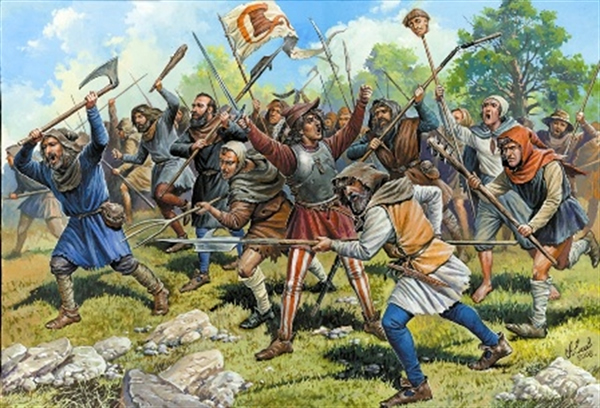
Yet, there was a limited school of thought that fell under the terminology “Radical Reformers”. These scholars (or more predominantly rebellious movements, such as those who participated in the German Peasants’ War of the 1520s) had less positive visions about the possibilities of state structures in reforming the Christian faith. The belief held by these radicals was that even a new form of the established church and accompanying magistrate rule might well be part of the ‘Corruption of Christendom’ that had already infected Rome. Therefore, the idea was to forward direct action from below – devout individuals and congregations (such as the Anabaptist tradition) should immediately reform themselves, regardless of the will of their rulers. Other than the Peasants War and the Anabaptists, this more radical tradition failed to hold sway for a significant duration.

Reaction to Context:
Turning to reactions to particular contexts that inspired these political thoughts of the Reformation period, we can see the heavy indebtedness to archetypal Protestant reformer, Martin Luther. Lutheran resistance consisted of rebelling against “supreme power”, when it threatens to destroy the true religion, and assisting the faithful in their resistance. Turning to Calvinist resistance, it must be the “ruling class” who themselves question the executive supreme magistrate’s authority, essentially a strata of rebellious inferior magistrates. The Church of England formulated resistance in a more legalist form, by signing the Treaty of Nonsuch in 1585, which committed English military and financial support to the Dutch rebels resisting the Spain of Philip II. This leads nicely onto the scriptural texts, precedents and arguments that raged between the resistors and reformers. First of all, there was a divide between the moderate “magisterial” reformers and the “radical” reformers. Both sides agreed on the rejection of the precedent allowing institutional authorities to govern Christian life – the Roman Church the spiritual side, and the Roman Empire the temporal realm. Scripture itself was used by the reformers to vindicate their repudiation of prior authority, such as the excerpt from Paul’s Letter to the Romans, “Let every soul be subject unto the higher powers” (Romans 13:1–2). But, one critical conceptual question to ask, is what actually counted as ‘tyrannical’ to the reformers to spur them on to rebel? Firstly, there were what were seen as centralising monarchies – royalty that sought to consolidate their power against the Protestant threat. Against this, the work of John Calvin inspired followers in France, the Netherlands and Britain to realise the right of inferior magistrates to resist tyrannical rulers. Also, in a more Lutheran bent, there was defensive action taken to defend the gospel itself against the tyranny of the papacy in the corrupted Christendom of the Roman Catholic Church.2

Finally, it is important to consider the interplay between the various conceptual realms of the ‘religious’, ‘political’ and ‘constitutional’ in this reforming thought. During medieval times, thinkers had debated whether the Roman Catholic Church and Roman Empire were and should be separate from one another, or as Gelasius had posed, that secular power was subordinate to the church’s power. However, the Reformation created a modern form of political theory – it concentrated on secular authority, the essential character and function and the shape of the state’s power. As Quentin Skinner writes on the period in his Foundations of Modern Political Thought: Volume 2, Reformation, the reformers served to make an indirect contribution to the idea of the modern state as an omnipotent ‘political’ power.3
From Religious Reform to Political Reform:
In the class itself, we looked at the precursory intellectual sphere of the reformers. This was a world of conciliarism, which forwarded the idea that a larger council of the Church of Rome may depose the Pope due to its greater authority of the amassed members, removing the infallible authority of the Pope himself as heir to Peter. Yet, on the other hand, the Pope also was able to wield deposing power himself, excommunications of the heretical and rendering monarchs illegitimate. Out of this complicated religious landscape, Protestants were able to appropriate the creative milieu of the power of excommunication and conciliarism as revealing the fallibility of the Pope (and leaders in general, both to their advantage. For example, the Presbyterian Church attempted to challenge the royal supreme power of James VI/I, because he sought to appoint his own bishops. Moreover, John Knox, a Scottish reformer who spent most of his time in exile, wrote the First Blast of the Trumpet which indicted the Catholic queen of England Mary I. In his (misogynistic) anti-catholic tome, Knox linguistically conflates women speaking in church with women speaking in politics, thereby using scripture (Timothy 2:12) to show why women shouldn’t be orators or leaders. This argument, for Knox being an academic of St. Andrews, was only further buttressed by the fact that even Aristotle argues that women shouldn’t be orators, so this support from the ancients seems to vindicate his thought.
One question that was raging during this period, was whether secular authority can regain over both ‘tables’ – the spiritual and the temporal. In other words, the reformers were starting to question whether the temporal magistrates could be responsible for the spiritual matters of the state, as well as the secular ones. The argument that the magistrate should have dominion over both, is found in the Appellation, where inferior magistrates are called upon to defend true worship and religion. Also, civic humanism is starting to arise at this point. Take Bodin’s view of absolute sovereignty, Buchanan responds to the Frenchman’s belief in supreme power, with the view that the law comes from the people themselves, not just the arbitrary whims of the Kings and total rulers. For Buchanan, political authority lies with the people, even in the election of Kings, and when the contract between the people and King is broken, the people have the ability to rebel. These arguments formed part of the longer Scottish contest over ecclesiastical and political authority that culminated in the National Covenant of 1638. The Covenant opposed Charles I’s attempted religious reforms while presenting itself as a defence of Scotland’s established religion and the king’s lawful authority. Moreover, it was difficult for the Covenanters to defend their document as reformers, since they were purposely vague on not defining what the true religion was in order to facilitate the various splintering Protestant sects, making it difficult to defend with very little definition.

Semantics & Statecraft:
At the same time, there was a linguistic turn in the use of the term ‘state’. This was a substantial shift, from the prior semantic affiliation with a ‘state of mind’ or ‘state of the prince’s power’, to the state itself as a mechanism of power. The difference of semantics here is also revealed through John Coffey’s work England’s Exodus: The Civil War as a War of Deliverance, through the differing opinions of the Parliamentarian party, as to what they’re fighting for exactly during the civil war. Some reformers saw themselves in the conflict as “defenders of Reformed Protestantism and opponents of popery”, and other, more Puritan revolutionary elements, saw the battle as “a war of liberation from political and ecclesiastical servitude.” Therefore, Coffey goes against Quentin Skinner’s idea that the secularisation of neo-roman liberty was the inspiration for the revolutionary turn of the civil war since this doesn’t take into account the theological sentiments of the time. Coffey raises the different appropriations that ‘legitimised’ resistance and create a ‘narrative frame’ for resistance events, i.e. Exodus, and Revelations. Coffey further opens up political discourse as a linguistic framework abstracted from the teaching to become its own thing. This means that Puritans, for example, were using the state in order to maintain order and control – repression through assured political virtue. 4

On the other hand to Coffey, Skinner was seeking to decouple religious ideas from the early modern period which is why he came to a very different conclusion of a neo-roman nature. Skinner’s orthodoxy focuses on scholastic and legal thought, but in reality, the English fear of Catholicism was prevalent in the emerging popular culture. Coffey notes that there was a deep fear of religious uniformity amongst the people, and this fear of uniformity transgressed from religious into political sentiment. Using religious imagery, Coffey writes they were worried that England may “return again to the bondage of Pharaoh.” Therefore, I think we can in fact see Coffey as complementary to Skinner’s work, by reintroducing the religious dynamic to the period. 5
Related Reading
Continue exploring related themes across The Intellectual Historian:
- Meddling with the Medieval.
- Rethinking the Middle Ages: Faith, Learning and Intellectual Change
- Natural Law and Natural Rights: Pufendorf, Sociability and Political Obligation
Notes
- Harro Höpfl, The Christian Polity of John Calvin (Cambridge: Cambridge University Press, 1982), 1–22 and 150–71. ↩
- Martin Luther, “Temporal Authority: To What Extent It Should Be Obeyed,” in Luther’s Works, vol. 45, ed. Walther I. Brandt (Philadelphia: Fortress Press, 1962), 81–129; John Calvin, Institutes of the Christian Religion, ed. John T. McNeill, trans. Ford Lewis Battles, 2 vols. (Philadelphia: Westminster Press, 1960), IV.20.31; Romans 13:1–2. ↩
- Quentin Skinner, The Foundations of Modern Political Thought, vol. 2, The Age of Reformation (Cambridge: Cambridge University Press, 1978), 349–52. ↩
- John Coffey, “England’s Exodus: The Civil War as a War of Deliverance,” in England’s Wars of Religion, Revisited, ed. Charles W. A. Prior and Glenn Burgess (Farnham: Ashgate, 2011), 253–80, especially 253–66. ↩
- Coffey, “England’s Exodus,” 266–72. ↩
Selected Bibliography
- Calvin, John. Institutes of the Christian Religion. Edited by John T. McNeill. Translated by Ford Lewis Battles. 2 vols. Philadelphia: Westminster Press, 1960.
- Coffey, John. “England’s Exodus: The Civil War as a War of Deliverance.” In England’s Wars of Religion, Revisited, edited by Charles W. A. Prior and Glenn Burgess, 253–80. Farnham: Ashgate, 2011.
- Gregory, Brad S. The Unintended Reformation: How a Religious Revolution Secularized Society. Cambridge, MA: Belknap Press, 2012.
- Höpfl, Harro. The Christian Polity of John Calvin. Cambridge: Cambridge University Press, 1982.
- Luther, Martin. “Temporal Authority: To What Extent It Should Be Obeyed.” In Luther’s Works, vol. 45, edited by Walther I. Brandt, 81–129. Philadelphia: Fortress Press, 1962.
- Skinner, Quentin. The Foundations of Modern Political Thought. Vol. 2, The Age of Reformation. Cambridge: Cambridge University Press, 1978.
Article word count: 1,760 words
Cite this article
Chicago style: Samuel Woodall, “Resistance and Reformation,” The Intellectual Historian, 3 March 2023, https://theintellectualhistorian.com/2023/03/03/resistance-and-reformation/.
Leave a Reply