
Acknowledgement of Supervision: Dr Rory Cox
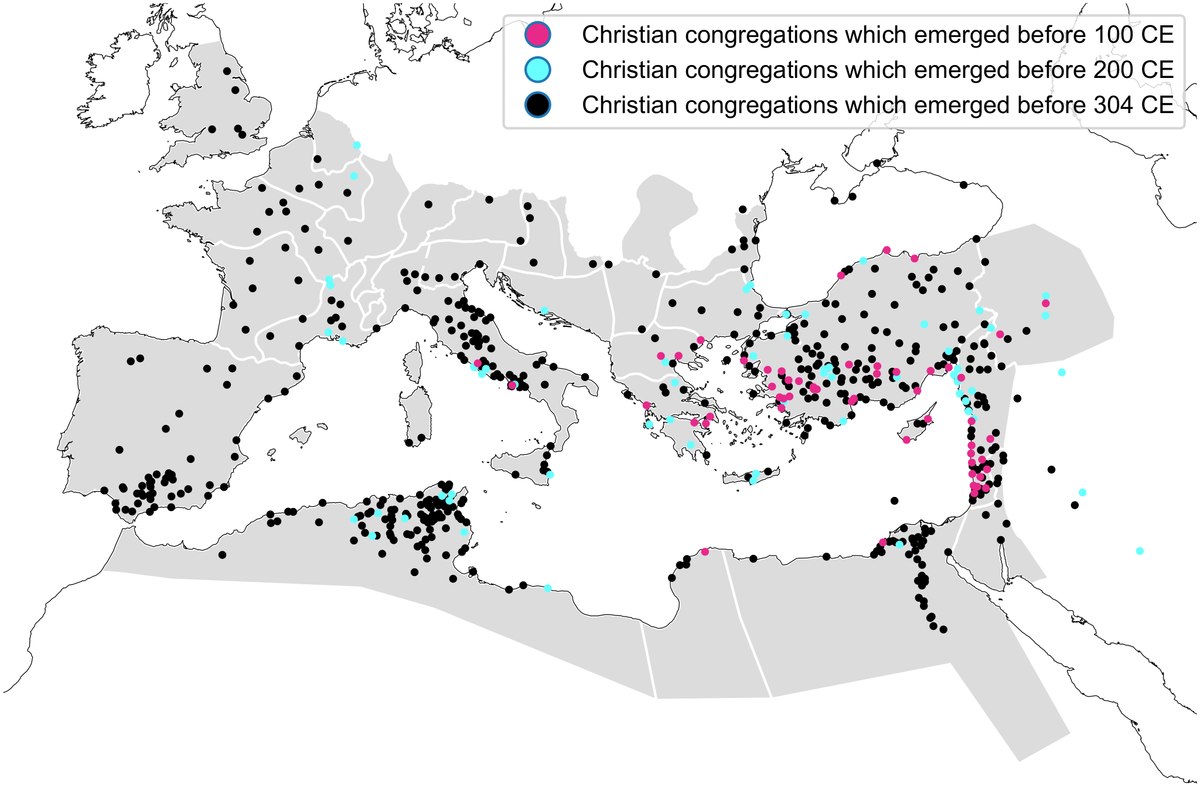
In week 3, we explored a period too often treated as an intellectual interval between classical antiquity and the Renaissance. Augustine’s City of God and Thomas Aquinas’s Summa theologiae show instead how Christian thinkers transformed Greek and Roman inheritances for new theological and political purposes. The imperial setting also changed in stages. Constantine ended official persecution and extended patronage to Christianity in the early fourth century, but Nicene Christianity became the empire’s official religion only under Theodosius I later in the century. This transformation altered the lived relationship between religion and political authority and created the conditions in which late-antique Christian political thought developed.1

Augustine:
Augustine’s two cities are defined not simply by institutional membership or by a visible division between church and state, but by rival loves. The city of God directs love towards God, whereas the earthly city is governed by disordered self-love and the desire to dominate. The two communities remain intermingled in history and will be perfectly distinguished only at the end of time. Augustine therefore does not identify every inhabitant of the Roman state with the earthly city, nor does he instruct Christians to abandon political life altogether. Earthly institutions belong to a fallen world and cannot deliver true justice or final happiness, but political peace remains a limited and genuine good used by members of both cities. Hierarchy is likewise not uniformly condemned: Augustine treats domination such as slavery as a consequence of sin while still recognising ordered relations within households and states. His position is deeply eschatological, but it is more politically qualified than a simple rejection of government as inherently evil.2

Aquinas:
Aquinas gives political community a more affirmative role because social life and government can direct human beings towards a common good. The Summa theologiae proceeds through questions, objections, a counter-statement and replies, using reasoned distinctions rather than a simple opposition between faith and observation. In his account of law, eternal law is divine reason governing creation; natural law is the rational creature’s participation in that order; and human law consists of particular rules derived from natural-law principles for specific communities. Divine law, disclosed through revelation, guides human beings towards their supernatural end and corrects the limits of human judgment. The ius gentium was not coined by Grotius: it was an established Roman legal term that Aquinas incorporated into his classification of human law, while Grotius later reworked the law of nations. Aquinas’s engagement with Aristotle was therefore substantial rather than merely decorative, but it remained part of a Christian synthesis in which political reason operated within a wider theological order.3

An Aristotelian Revolution?
After observing these texts, we can begin to question whether, as scholarship has longed posed, there was in fact an “Aristotelian Revolution” as such. It is certainly clear that there was an intellectual flurry with various forms of the transmission of ideas coming about. During the medieval age, the re-emergence of the texts of the Ancients came in specific forms – for example, Commentaries, which would consist of a central Decretal, around which the commentary would be penned on the sides of the page. This would be the ‘Standard Commentary’, however, its position as the norm rather than universal, implies that at the time, there was debate and discussion and that the texts could’ve been seen as controversial. The translation was also crucial in understanding how thoughts and ideas were interpreted during the period. Moreover, the Florilegia were also pivotal intellectual compilations and collections of manuscripts, in an encyclopedic style of research. Often, excerpts of the Florilegia would merge with commentaries, highlighting their shared importance in the formation of thought during the era. Additionally, there were handbooks of political thought, one example being the Mirror of Princes.

The reception of Aristotle’s Politics did alter the language available to Latin political thinkers, but “Aristotelian Revolution” should be treated as an interpretive label rather than a single event. William of Moerbeke produced an incomplete Latin translation between 1260 and 1264 and a complete version probably before 1267. The text then circulated through commentaries and lectures, although it was not uniformly embedded in university curricula. Aristotle’s claim that collective judgment may surpass the judgment of isolated individuals became one important resource, as did his account of the human being as a political animal. These arguments did not simply erase older traditions; they were read alongside Roman law, Christian theology, Cicero and existing practices of government. The change is therefore better understood as an extended process of translation, commentary and selective appropriation than as an abrupt epistemological break around 1250.4
Revolutions of Knowledge?
This raises a broader question: what counts as a revolution in knowledge? Aristotle’s political naturalism gave thinkers such as Aquinas new resources for explaining political community and law, but those resources entered traditions already shaped by scripture, patristic authority, Roman law and medieval institutions. Nor should the ecclesiastical interventions of the thirteenth century be collapsed into a single “Condemnation of 1210–1277.” The prohibitions at Paris in 1210, the condemnation of thirteen propositions in 1270 and Bishop Stephen Tempier’s condemnation of 219 propositions in 1277 were distinct acts with different targets and contexts. They constrained teaching, but their relationship to intellectual innovation remains historically contested.5

The effects of the 1277 condemnation were real but uneven: some scholars altered positions on questions such as the eternity of the world and the powers of God, while Aristotelian study continued. Pierre Duhem later argued that the condemnation liberated inquiry from Aristotelian necessity and marked the “birth of modern science.” That thesis was influential in the historiography of medieval science, but it is no longer accepted as a scholarly consensus. The larger pattern is one of gradual and discontinuous change. Translations, commentaries and florilegia had long mediated ancient thought; the fuller reception of the Politics intensified debate without producing a clean break between two coherent ages. Avoiding what Skinner called the “mythology of coherence” allows the period’s conflicts, continuities and competing intellectual languages to remain visible.6
Related Reading
Continue exploring related themes across The Intellectual Historian:
- Intellectual History: A Guide to Ideas in Context
- Rethinking the Middle Ages: Faith, Learning and Intellectual Change
- Resistance and Reformation.
- All the Classics…
Notes
- Christian Tornau, “Augustine of Hippo,” Stanford Encyclopedia of Philosophy, substantive revision 26 April 2024, sections 1 and 8, https://plato.stanford.edu/entries/augustine/. ↩
- Augustine, The City of God against the Pagans, ed. and trans. R. W. Dyson (Cambridge: Cambridge University Press, 1998), XIV.28 and XIX.12–17; Tornau, “Augustine of Hippo,” section 8. ↩
- Thomas Aquinas, Political Writings, ed. and trans. R. W. Dyson (Cambridge: Cambridge University Press, 2002), De regno I.1–6; Thomas Aquinas, Summa theologiae, I–II, qq. 90–97, especially q. 91, aa. 1–4 and q. 95, a. 4. ↩
- Cary J. Nederman and Alessandro Mulieri, “Medieval Political Philosophy,” Stanford Encyclopedia of Philosophy (2025), sections 1 and 8, https://plato.stanford.edu/entries/medieval-political/; Aristotle, Politics, trans. C. D. C. Reeve (Indianapolis: Hackett, 1998), III.11, 1281a39–b21. ↩
- Hans Thijssen, “Condemnation of 1277,” Stanford Encyclopedia of Philosophy, substantive revision 18 December 2023, sections 1–5, https://plato.stanford.edu/entries/condemnation/. ↩
- Thijssen, “Condemnation of 1277,” section 5; Quentin Skinner, Visions of Politics, vol. 1, Regarding Method (Cambridge: Cambridge University Press, 2002), 67–72. ↩
Selected Bibliography
- Aquinas, Thomas. Political Writings. Edited and translated by R. W. Dyson. Cambridge: Cambridge University Press, 2002.
- Aristotle. Politics. Translated by C. D. C. Reeve. Indianapolis: Hackett, 1998.
- Augustine. The City of God against the Pagans. Edited and translated by R. W. Dyson. Cambridge: Cambridge University Press, 1998.
- Nederman, Cary J. Lineages of European Political Thought: Explorations along the Medieval/Modern Divide from John of Salisbury to Hegel. Washington, DC: Catholic University of America Press, 2009.
- Nederman, Cary J., and Alessandro Mulieri. “Medieval Political Philosophy.” Stanford Encyclopedia of Philosophy. 2025. https://plato.stanford.edu/entries/medieval-political/.
- Skinner, Quentin. Visions of Politics. Vol. 1, Regarding Method. Cambridge: Cambridge University Press, 2002.
- Thijssen, Hans. “Condemnation of 1277.” Stanford Encyclopedia of Philosophy. Substantive revision 18 December 2023. https://plato.stanford.edu/entries/condemnation/.
- Tornau, Christian. “Augustine of Hippo.” Stanford Encyclopedia of Philosophy. Substantive revision 26 April 2024. https://plato.stanford.edu/entries/augustine/.
- Ullmann, Walter. A History of Political Thought: The Middle Ages. Harmondsworth: Penguin, 1965.
Article word count: 1,057 words
Cite this article
Chicago style: Samuel Woodall, “Medieval Political Thought: Augustine, Aquinas and Aristotle,” The Intellectual Historian, 2 March 2023, https://theintellectualhistorian.com/2023/03/02/meddling-with-the-medieval/.
Leave a Reply