
Acknowledgement of Supervision: Dr Rory Cox
By week 3, we were delving into the realm of an often highly protective discipline, Classics. We had been set a choice of texts to review for the first seminar of the week on the Turning Points in intellectual history. Out of the Ancients, I chose to review Plato’s Crito and Book One of the Republic, alongside the Analects by ancient Chinese scholar Confucius.
Crito:
The first of these I had in the form of the 1969 compilation under the name The Last Days of Socrates. In the Crito section itself, Plato posits a form of proto-contract theory, that there is a responsibility laid out for individual agents within the polity, due to their implicit consent given by growing up and taking the rights and privileges of said society. Plato reveals this when he writes “Did we not give you life in the first place?”, implying that it is only through the polity’s care and nurturing that an agent has come to be a functioning agent. Further, Plato pens that subsequently to accepting this upbringing the agent “Has in fact undertaken to do anything we tell him.” This is an early iteration of what John Locke will later refer to as tacit consent, or submitting to a society’s laws and regulations as you choose to live within its bounds and take its blessings and bestowals. 1
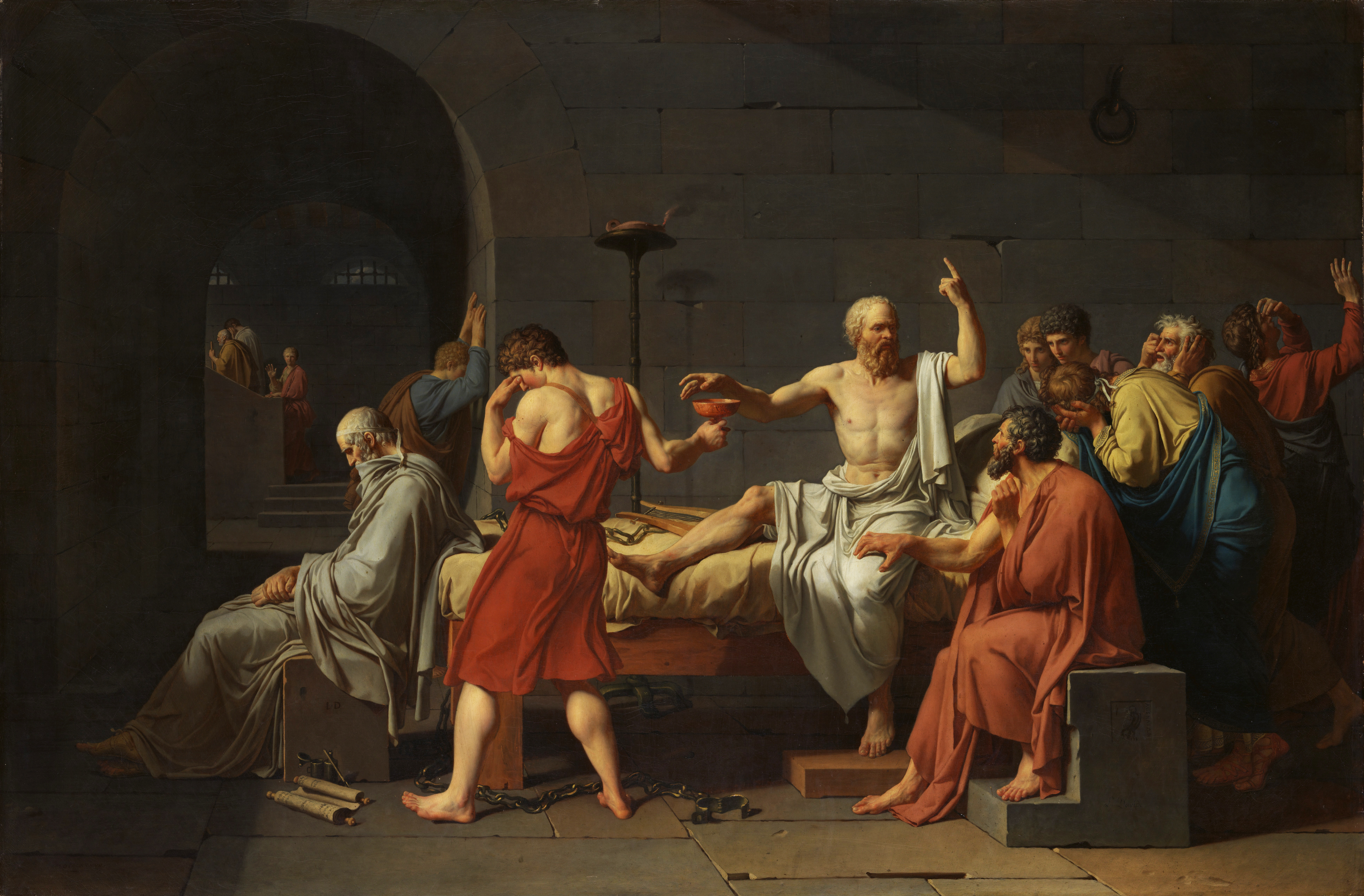
There is a strong ‘Contractarian’ notion in the text, which is a form of social contract theory that grounds morality in the state and the laws of a society – e.g. Hobbes’s belief in the supreme power of the state to save us from the bestial state of nature, or even Vico somewhat in his anthropological observation that laws are just the natural way of human functioning – rather than what would later become a ‘Contractualist’ theory which believes in a pre-existing code of ethics that the structures of the state are built around – e.g. Kant believes in precursor ethical maxims that’s the legislation of society should then be structure round, or in a religious paradigm, Aquinas believes human law should comply with divine and eternal law. Plato indicates his preference toward the former, writing “Do you imagine that a city can continue to exist… if legal judgements… have no force, but are nullified and destroyed by private persons?”In this bent, Plato promulgates a strong sense of duty to observe the Laws of the land which are fundamental to the maintenance of a moral society. The clearest vehicle of such a vision is Socrates’ death itself, drinking the hemlock given to him, after being offered a reprieve to leave the city. He turns this final offer down, accepting that having lived by the laws of the city, he must die by them also. His conviction and devotion make him a contractarian martyr, representing the total end and standard of what a moral society must live (and die) up to.2

Other schools of thought had been operating more ‘contractualist’ notions of how to structure society at the time. We can see a proto version of this in the Epicurean writings such as the Principal Doctrines, in which duty in society is a code of ethics. This ethics is determined by “reciprocal benefits” and mutual dealings – a formulation similar to what will be observed later in Kant’s categorical imperative in the Groundwork to the Metaphysics of Morals.3
The Republic: Book I
Turning to Book One of the Republic, I was using a 1955 edition published under Penguin Classics. The first matter to tackle is Plato’s portrayal of the battle between the rational and the irrational. For him, the passions are the latter and lead to an unethical life, which takes one away from the rational which reveals the end of the ethical truths. As he writes, the ethical man has “Escaped from the madness and slavery of passion.”But in order to manage this escape to the ethical life, the character of the person must be steadfast. The idea of an ethical character is one that understands truth amongst the lies and fallacies of the temporal realm, thereby only the intangible ‘soul’ transcends this and realises truth. The material realm can not satisfy the soul, it must seek higher things, as Plato notes “a bad man won’t be contented even if he is rich.” 4
But then if this mortal plain serves no truth, we must delve into what Plato really means by justice in the world. He points out the fact that this crucial concept of how to run a society can’t just be the arbitrary whim of being immoral for moral purposes. This would just be a “kind of stealing, though… done to help a friend or harm an enemy.” So then, Plato turns to the notion that often holds in our contemporary world, that justice is a form of penal punishment. However, he disputes the legitimacy of this claim, since why would a moral society be retributive and treat the immoral immorally – only entrenching the immoral (a claim followed up by Kant later)? The ‘good’ agent should not use the ‘bad’ act to reform the corrupted, “will good men use their goodness to make others bad?” So then, Plato turns to a cynical interpretation of justice, that it is merely the interest of whoever maintains the advantage in power relations. He writes that, as if throwing his arms up in disillusionment, “justice or right as what is in the interest of the stronger party.” These words are conveyed through the vehicle of Thrasymacus, who had derided the whole conversation of the concept as esoteric and subsequently to no practical avail. What Plato is here posing, is that what will be defined ultimately as “right” will always be the the stronger party’s interest, for a “democracy [creates] democratic laws, a tyranny tyrannical ones.”5
However, this can’t be the “right” way to govern, for a master (leader) of an art or science will always rule in the interest of furthering the weaker party. This is exemplified through examples of masters of their arts, such as with sailors: “A captain will not give orders with his own interest in view, but that of the crew which he controls.” We can see that it is knowledge in the master’s field which comes alongside goodness here. Therefore, “the just man is wise and good, and the unjust bad and ignorant.” A state will need justice, as it implies knowledge and informed leadership, to maintain its integrity and strength. There will be the “prospect of greater success if they don’t wrong each other.”6
On the flip side, if injustice is allowed to propagate in a society, it will affect both division in the body politic and in the mind of the agent. This is because it “renders him incapable of action.” Plus, as the Gods are just, the unjust man is thereby an enemy of the Gods themselves. Moreover, looking at the mind, it is said that “everything which has a function has its own particular virtue or excellence.” Thereby, the mind itself has “its particular virtue”. If the mind is deprived of its virtue, it is also deprived of working well. This is because, “goodness enables the minds to perform its functions well.” This means that, as justice is the virtue of the mind, justice will bring the “good life”, and a good life is both “prosperous and happy”. Therefore, “justice pays better than injustice”.7

Analects:
Finally, I turned to Confucius’ Analects, using James Legge’s translation. I had only briefly encountered the work of Confucius once before when studying classical political thought during my undergraduate study. Alongside Socrates and the Buddha, the three shared a very close period, which transformed thinking in the far east, the subcontinent and Europe.
In the text itself, Confucius starts by outlining virtue. He poses that virtue itself is to treat everyone in such a behaviour as it would be that you were “receiving a great guest.” This implies that no matter class or status, every interaction one has with another should be conducted with respect and compassion. He moves on from this notion, to lay out what appears to be an iteration of the Golden Rule of Christendom – a contractualist notion of “Not to do to others as you would not wish to be done to yourself.” This is an interesting philological cross-comparison, for the Greeks also developed a similar phraseology simultaneously, in the words of Thales (c.624-c.546 BCE) “Avoid doing what you would blame others for doing.” And, of course, this would become prominent through the teaching of Christ himself – during the Sermon on the Mount, he proclaimed “Do unto others as you would have them do unto you.” However, the fact that the Ancients already had preliminary iterations of this rule is interesting to look at from both a philological influence perspective, but also a cross-cultural anthropological one – that scholars and statesmen were dreaming up the same notions for their respective societies. 8
Confucius then turns to how to attain a perfect virtue, which he says comes from prudence and calm consideration of the situation, and that one must be “cautious and slow in his speech” to mitigate rash decisions. Out of this, one must also be authentic in their actions and decisions, for being true to oneself is to be a superior virtuous individual with “neither anxiety nor fear.” After this, he turns to the sins of flattery and insult, but these when used as a method attack against a virtuous individual, should not affect the virtuous – for he is steadfast in fortitude: “Neither soaking slander, nor startling statements, are successful, he may be called farseeing.” Then, Confucius turns to the processes of ceremony and ritual, which he sees as important for constancy, for “ornament is a substance; substance is an ornament”. By this, he means that there is something inherently valuable in the ritualistic acts of a community to bind it together – the ‘ornament’ or ceremony, has its own ‘substance’ or importance to the people. 9

Further on, Confucius pens that one should always be in search of truth and put sincere faith in this daunting quest. He writes that the individual must be “moving continually towards what is right.” In this way, to rule, the mind must be fully occupied with the business of government and what is right for the nation, and never distracted away from this. The right way to govern must be “before the mind without weariness”. Again, he reiterates that the moral path will be trodden by those who continue to search for it and learn and observe the rules and conventions of their time. This makes his ethic both one of striving, but within a legalist framework, “extensively studying… [within] restraint of the rules of propriety.”10
Once again, similar to the world of the Ancient Greeks, in this case, Plato, justice and a just and right society come not from punitive and retributive justice, but from first of all improving the good, virtuous and moral character, to “perfect the admirable qualities of men”. And then also, by leading by example, as Confucius puts it metaphorically, “the grass must bend, when the wind blows across it.” This means that if the rulers of the land have the virtuous qualities of a moral character, then their paternal influence will guide the rest of society towards that moral goodness also. Therefore, the ruler of the land must employ the “upright” as his advisers and consorts, since this will then trickle down through the land so that those “devoid of virtue” will “disappear”.11
One final point is that Confucius makes a stark distinction between the man of fame and the man of genuine distinction. The latter “loves righteousness” and is humble in his way, whereas the former “assumes the appearance of virtue” whilst at the same time having no “doubts about himself. This means that the man of distinction is the authentic self, knowing not to boast about his goodness, whilst the man of fame seeks to get praise for his assumed goodness whilst not realising his inauthenticity by never questioning himself internally.12
The Axial Age:
In the class itself, after discussing the set texts, we set about analysing what was known as the ‘Axial Age’. Now, this term was first invented by philosopher Karl Jaspers in Heidelberg in the late 1940s. He was heavily influenced by the work of G.W.F. Hegel, and the concept itself is a broad periodisation of the years between the 8th and 3rd century BC. It suggests that there was a duration of religious and philosophical transformation across the Greco-Roman world, through the Levant and Persia, to China. What it explicitly does not include is Africa, the Americas or Oceania. The integrity of this structure is extremely fragile in its homogenising tendency to suggest that these changes were happening in synchrony, and substantial figures who caused paradigm shifts in thinking (e.g. Jesus and Mohammed) are not included within the set timeframe. However, it is clear that without coming into contact with one another, these various cultures were formulating similar ideas in years not too dissimilar to one another.13

We have seen Plato and Confucius listed as components of this ‘Axial Age’ in the readings set, but let us turn to the pre-axial age. During this time, the binary of the transcendent (metaphysical) and mundane (physical) was intertwined. This can be seen through such figures in stories and tales as oracles, kings and the like. This intertwining stimulated an internal interrogation in the ancient world, for the divine could be used to legitimate positions of power (such as Kinghood), but also in scripture needed to be quite distinct from those on this mortal plain. Therefore, the ‘Axial Age’ scholars began to question the fallacies and myths of the past by posing that the transcendent and physical worlds were two completely separate realms that did not overlap like suggested in the days of old.
Clearly, around the world there was a zeitgeist for change, as simultaneously scholars questioned the old order and began to pen their agenda for new societies. But, how simultaneous were these shifts in thought? Were there multiple periods of axiality? What are the common factors affecting intellectual developments in the different corners of the globe, or are they different? When these fundamentals are critiqued, we see that the ‘Axial Age’ still relies heavily on a Western-hegemonic notion that all other developing intellectual cultures need to fit in with what was changing in the West and when. It may be seen to be much more fruitful to analyse these scholars, their ideas and their subsequent influence on a case-by-case basis and within their own temporal context.14
Related Reading
Continue exploring related themes across The Intellectual Historian:
- Justice and the Good Society: Plato, Aristotle and Ancient Greek Political Thought
- Beginnings in Intellectual History: Context, Texts and Method
- Rethinking the Middle Ages: Faith, Learning and Intellectual Change
Notes
- Plato, Crito 50d–52d, in The Last Days of Socrates, trans. Hugh Tredennick, rev. ed. (Harmondsworth: Penguin, 1969). ↩
- Plato, Crito 50a–54d. ↩
- Epicurus, Principal Doctrines 31–38, in The Epicurus Reader, trans. Brad Inwood and L. P. Gerson (Indianapolis: Hackett, 1994). ↩
- Plato, Republic 328b–331d, trans. H. D. P. Lee (Harmondsworth: Penguin, 1955). ↩
- Plato, Republic 331e–339a. ↩
- Plato, Republic 341c–351c. ↩
- Plato, Republic 351c–354c. ↩
- Confucius, Analects 12.2, trans. James Legge, in The Chinese Classics, vol. 1, 2nd ed. (Oxford: Clarendon Press, 1893); Diogenes Laertius, Lives of Eminent Philosophers I.36; Matthew 7:12. ↩
- Confucius, Analects 12.3–6 and 12.8. ↩
- Confucius, Analects 12.10 and 12.14–15. ↩
- Confucius, Analects 12.17–19. ↩
- Confucius, Analects 12.20. ↩
- Karl Jaspers, The Origin and Goal of History, trans. Michael Bullock (New Haven, CT: Yale University Press, 1953), 1–21. ↩
- Jaspers, Origin and Goal of History, 1–21. ↩
Selected Bibliography
- Confucius. Confucian Analects. Translated by James Legge. In The Chinese Classics, vol. 1. 2nd ed. Oxford: Clarendon Press, 1893.
- Diogenes Laertius. Lives of Eminent Philosophers. Translated by R. D. Hicks. 2 vols. Cambridge, MA: Harvard University Press, 1925.
- Epicurus. The Epicurus Reader. Translated by Brad Inwood and L. P. Gerson. Indianapolis: Hackett, 1994.
- Jaspers, Karl. The Origin and Goal of History. Translated by Michael Bullock. New Haven, CT: Yale University Press, 1953.
- Lane, Melissa. Greek and Roman Political Ideas. London: Penguin, 2014.
- Plato. The Last Days of Socrates. Translated by Hugh Tredennick. Revised edition. Harmondsworth: Penguin, 1969.
- Plato. The Republic. Translated by H. D. P. Lee. Harmondsworth: Penguin, 1955.
Article word count: 2,517 words
Cite this article
Chicago style: Samuel Woodall, “Plato and Confucius: Justice, Virtue and Political Obligation,” The Intellectual Historian, 2 March 2023, https://theintellectualhistorian.com/2023/03/02/all-the-classics/.
Leave a Reply