
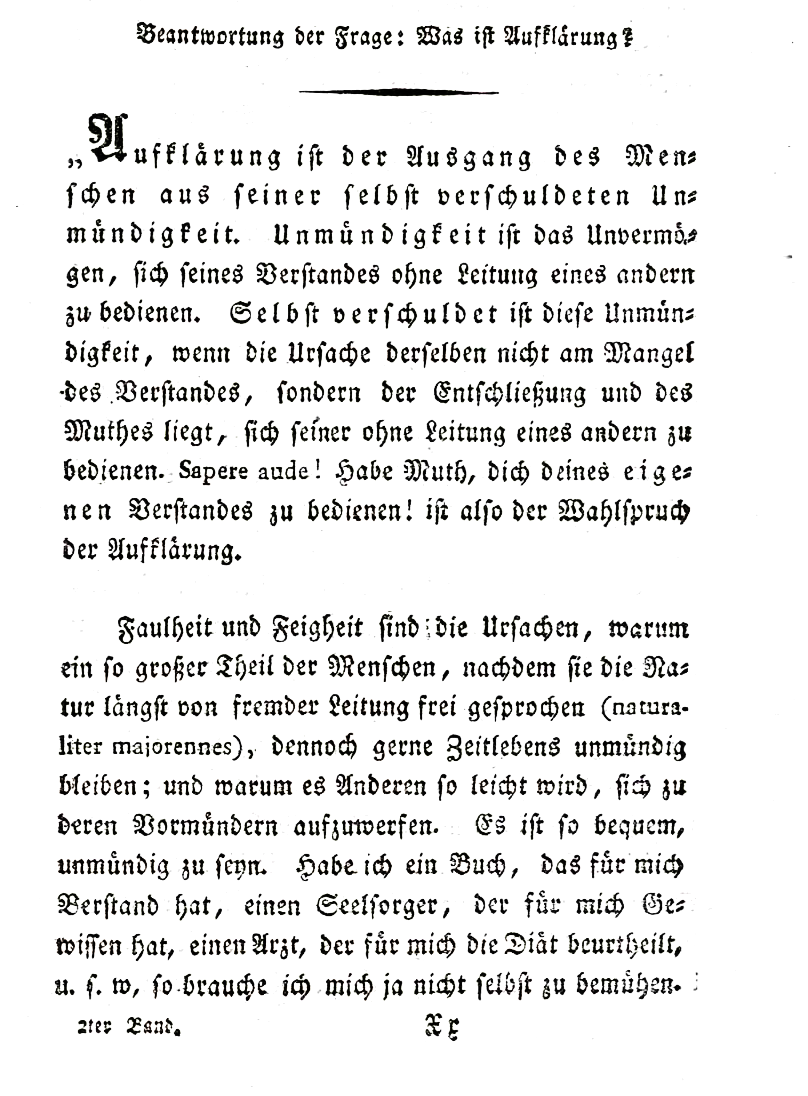
“Think for yourself” is easy advice to applaud. It becomes more difficult when we ask how anyone learns to do it. We acquire language, arguments and standards of evidence from other people. Independence cannot mean beginning with nothing borrowed. It must involve a different relationship to what we inherit.
Our first Kant conversation on Beyond the Text begins here, moving from his life in Königsberg to the question of enlightenment. A useful way to extend that conversation is to distinguish the confidence to express an opinion from the responsibility to give reasons for it.
The courage to examine
Kant’s 1784 essay links intellectual maturity with the courage to use one’s understanding. His target is a dependence in which other people’s judgements do the work that we ought to attempt ourselves. The point is unsettling because dependence can be comfortable. A ready-made answer relieves us of the risk of being mistaken.
The essay also describes habits that are cultivated and reinforced. That makes a purely individual reading inadequate. If opportunities to practise judgement have been restricted, exhortation alone will not supply them. We need to ask what kinds of education and public discussion enable a person to become answerable for a belief.
An argument inside institutions
Kant’s public use of reason concerns addressing the reading public. His private use concerns reasoning within an assigned civic or institutional role. The distinction allows him to defend public criticism while accepting restrictions attached to an office. It also leaves a question for the reader: can that boundary protect intellectual freedom adequately?
Consider the difference between carrying out a shared procedure and defending that procedure as just. An institution may require the first to function. Whether it can demand the second is a further matter. Reading Kant closely makes us notice how easily practical compliance and intellectual assent can be confused.
This is also a reason to read the essay historically. Its audience, examples and political setting matter. We lose something if we turn a specific intervention in eighteenth-century debate into a collection of timeless motivational lines. Historical distance can sharpen an argument by making its assumptions visible.
Why a philosophy of reason asks about limits
The Critique of Pure Reason, first published in 1781 and revised in 1787, investigates the conditions of possible experience and the limits of theoretical knowledge. Kant’s critical philosophy therefore does more than celebrate the power of the mind. It asks where claims to knowledge are warranted.
That gives the invitation to think independently a demanding companion. We must examine our entitlement to a conclusion as carefully as we examine the authority of whoever first supplied it. Replacing another person’s unsupported certainty with our own would leave the central difficulty untouched.
For an intellectual historian, this suggests a practical discipline. Ask what question a writer thought required an answer. Identify the distinctions that make the answer possible. Then ask what those distinctions clarify, what they exclude and where their application becomes difficult. Agreement can come later.
What would independent judgement look like?
One test is whether a person can give an account of a belief without merely naming the people who share it. Another is whether they can describe the strongest objection fairly. A third is whether they can identify evidence that would require revision. These are questions we can bring to our own reading; they are not a checklist supplied by Kant.
Trust remains necessary. Nobody can personally reproduce every experiment, inspect every archive or master every language. The relevant question is how we distinguish justified reliance from surrendering judgement altogether. Expertise should help us understand what warrants a claim and where its uncertainty lies.
That is the question I would carry from the opening episode into the rest of the series. How can we learn from others while becoming more capable of examining what they teach? The history of ideas offers many guides. Its value depends partly on whether we learn to question them.
Listen and read
Listen to the episode · Watch on YouTube
Read Kant’s “What Is Enlightenment?” (1784), translated by Mary C. Smith. For background, see the Stanford Encyclopedia of Philosophy entry on Kant.
Explore the Kant conversation
Episode guide and chapter links · Thinking for Yourself: companion essay · Reading-club questions
Leave a Reply