
The Warburg Institute, London, 22 September 2026
There was something particularly fitting about Anthony Grafton opening the 2026 E. H. Gombrich Lectures with a return to Joseph Scaliger. Delivered at the Warburg Institute as the first of three lectures on Joseph Scaliger in Leiden (1593-1609): Culmination and Crisis of a Learned Life, “Scaliger: Critic and Forger” returned Grafton to the scholar with whom his own scholarly career has been intertwined for more than half a century. Yet this was no retrospective. Instead, Grafton used that return to pose a deceptively difficult question: what happens when one of early modern Europe’s greatest critics turns out also to have been a forger?
The setting mattered. Grafton recalled arriving at the Warburg with his late wife Louise in 1973, during a Britain of strikes, power cuts and IRA bombings, and entering an intellectual world populated by figures including Arnaldo Momigliano and Ernst Gombrich. More than an autobiographical aside, this established the intellectual tradition within which the lecture operated. From Momigliano’s work on antiquarianism to Gombrich’s combination of the history of ideas, scholarship and style, the Warburg provided an appropriate setting for a lecture concerned with the strange ways scholars reconstruct the past.
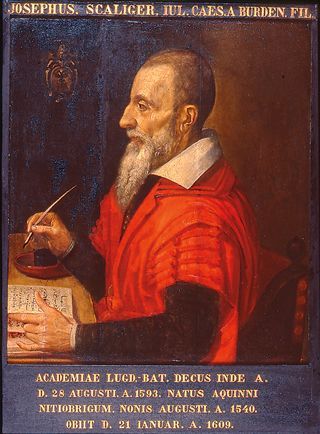
At its centre stood Joseph Scaliger (1540-1609), one of the extraordinary polymaths of the late Renaissance. Grafton presented a scholar whose appetite for knowledge seems almost unimaginable today: classical editor, chronologist, epigrapher and linguist, working sixteen-hour days and extending his investigations across Greek, Hebrew, Arabic, chronology and biblical criticism. His appointment at Leiden was itself an acknowledgement of scholarly celebrity. He was paid handsomely and, remarkably, released from teaching obligations, although he taught anyway, counting the young Hugo Grotius among those he instructed.
Yet alongside Scaliger the critic stood Scaliger the fabricator.
The problem began with his father, Julius Caesar Scaliger, who claimed descent from the della Scala, the medieval rulers of Verona. The claim was false. But rather than quietly inheriting his father’s fiction, Joseph transformed it into an elaborate scholarly construction. His Epistola de vetustate et splendore gentis Scaligerae supplied genealogies, historical narratives and documentary evidence intended to establish the antiquity and splendour of the family.
Here Grafton reached the central paradox of the lecture. Scaliger knew precisely how to identify forged evidence. Renaissance critics understood that an extraordinary document, unsupported by independent testimony and conveniently unavailable for inspection, should arouse suspicion. Scaliger himself had deployed such techniques against other fabricators. Yet when confronted with precisely these characteristics in his own family history, his critical faculties were suspended.
The result was both intellectually fascinating and, in Grafton’s telling, frequently very funny. Scaliger’s opponent Kaspar Schoppe subjected the genealogy to merciless scrutiny, discovering chronological impossibilities, consulting surviving members of the genuine della Scala family and exposing inconsistencies in Scaliger’s accounts. In one memorable calculation, Scaliger somehow managed to subtract 454 from 1484 and arrive at 1,130. Schoppe gleefully wondered at this new form of arithmetic from one of Europe’s greatest chronologists.
Most revealing was Scaliger’s supposed family book, described in extraordinary material detail and presented as evidence both for his ancestry and for the early history of printing. Across different retellings, however, its contents shifted. A book of hours became a psalter; details of its binding changed; most significantly, the name of its supposed owner altered when inconvenient evidence emerged. And why could this decisive artefact not simply be produced? A greyhound had destroyed it. As Grafton observed with evident amusement, the dog had quite literally eaten the evidence.
Yet reducing this to hypocrisy would miss what made the lecture so compelling. Scaliger’s fabrication itself produced scholarship. His invented book encouraged serious consideration of early printing and material bibliography. The same critical imagination capable of dismantling falsehoods could construct remarkably convincing ones.
Grafton therefore left us with a Scaliger considerably more complicated than either heroic scholar or dishonest forger. His defence of his ancestry was not merely an inherited delusion. He actively extended it, manufactured evidence for it and ignored the very warning signs his scholarship had taught others to recognise.
The significance extends beyond Scaliger. Scholarship is often imagined as a contest between criticism and credulity, truth and falsehood. Grafton instead revealed how uncomfortable the boundary can become. In Scaliger, critic and forger inhabited the same scholarly mind, using many of the same techniques. It was an appropriately Warburgian beginning to the series: erudite, humorous and unsettling, and one which leaves the larger question of why Scaliger needed his imagined ancestry so badly hanging tantalisingly over the lectures still to come.
Article word count: 753 words
Cite this article
Chicago style: Samuel Woodall, “Review: Anthony Grafton, ‘Scaliger: Critic and Forger’ – E. H. Gombrich Lectures 2026, Lecture I,” The Intellectual Historian, 23 September 2026, https://theintellectualhistorian.com/2026/09/23/review-anthony-grafton-scaliger-critic-forger-gombrich-lecture-2026/.