
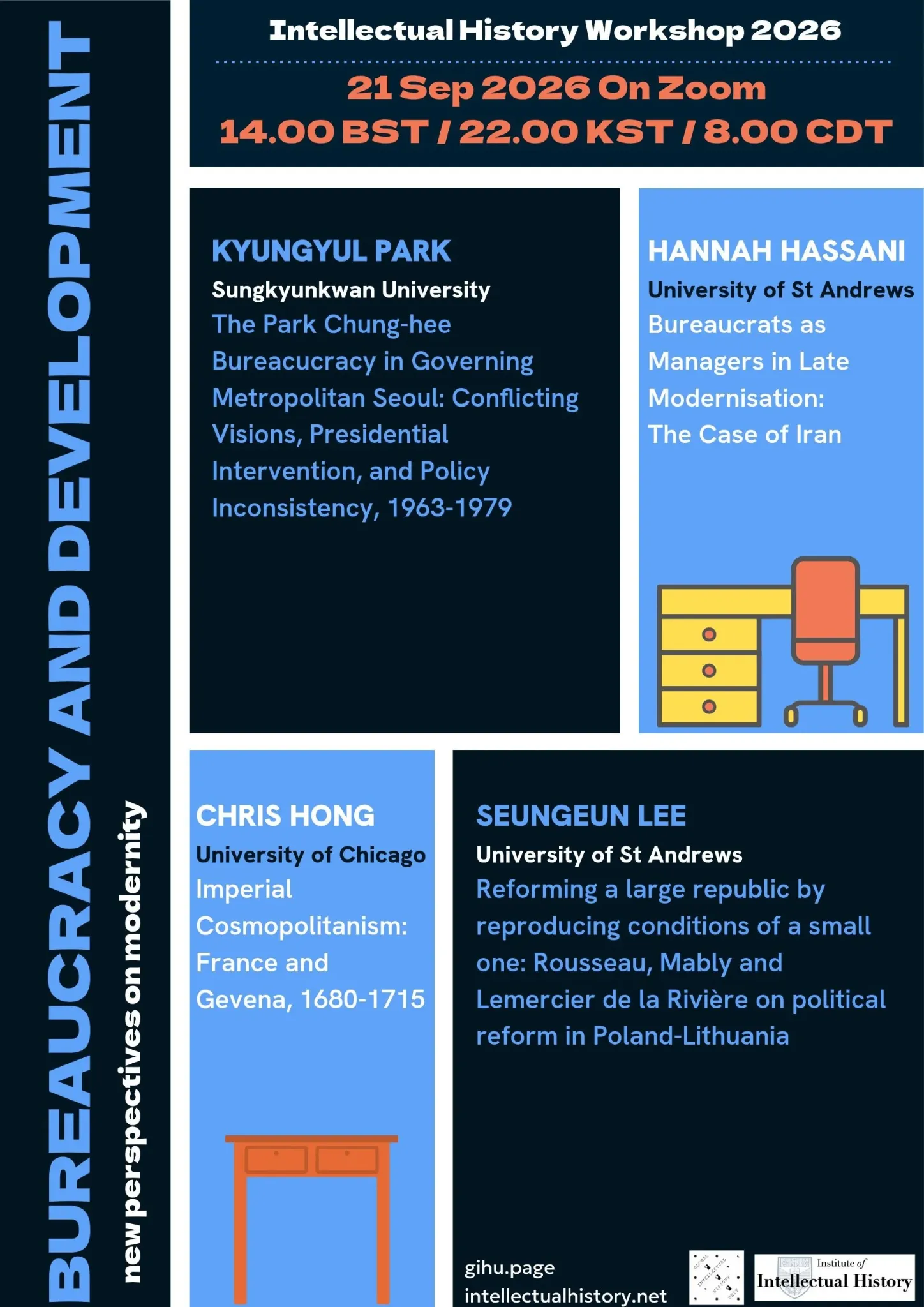
Bureaucracy and Development: New Perspectives on Modernity. Online workshop, 21 September 2026.
The relationship between bureaucracy and modernity provided the organising question for this stimulating workshop, which brought together four papers spanning European and Asian history. Its geographical and chronological breadth encouraged contributors to test familiar categories against markedly different political circumstances. Particularly rewarding was the attention paid to the people who staffed institutions, the languages through which they justified reform, and the distance between administrative ambition and practical achievement.
Kyungyul Park’s contribution, from Sungkyunkwan University, examined the governance of metropolitan Seoul under Park Chung-hee between 1963 and 1979. His account challenged the retrospective image of a cohesive developmental state by foregrounding competition between ministries and the fragility of presidential coordination. Bodies dependent upon the president’s personal intervention struggled to maintain authority when his attention shifted elsewhere. Efforts to restrain metropolitan concentration consequently became entangled with policies that extended its geographical reach. The paper’s strength lay in showing how the exercise of central authority could generate administrative instability, complicating assumptions about the relationship between authoritarian government and effective planning.
Hannah Hassani, of the University of St Andrews, approached related questions through the changing profiles of Iran’s senior administrators. Her examination of families whose public service extended across the Qajar and Pahlavi periods offered a persuasive account of institutional transformation within a relatively continuous elite. New educational experiences, legal qualifications, and administrative responsibilities changed the relationship between officials and the state without necessarily displacing established families.
Especially valuable was Hassani’s caution about comparing offices whose titles concealed substantial changes in function. Her distinction between administration rooted in household authority and bureaucracy organised around legally defined positions supplied a useful framework for the wider discussion. The persistence of patronage qualified this transition, while the codification of official duties established new standards against which conduct could be judged. Her contribution thus opened an important question about the historical significance of legal accountability even where its practical enforcement remained uncertain.
Seungeun Lee, also of St Andrews, turned to Rousseau, Mably, and Lemercier de la Rivière’s proposals for reforming Poland-Lithuania. Her emphasis upon their shared reform agenda challenged readings dominated by disagreements over particular constitutional mechanisms. Federative representation, graduated executive promotion, and gradual political inclusion emerged as responses to the difficulties of sustaining liberty within a large republic. This approach recovered possibilities easily obscured by narratives organised around the Commonwealth’s eventual partition.
Lee’s paper also prompted one of the workshop’s most probing exchanges. Questions about how graduated promotion reproduced the conditions of small-state government pressed the distinction between a reformer’s declared purpose and the institutional means proposed to achieve it. The discussion identified public scrutiny and proximity as central concerns, while leaving scope for further explanation of their relationship to successive stages of officeholding. This was a productive point of enquiry into the reasoning connecting constitutional proposals with their intended effects.
Chris Hong, of the University of Chicago, explored France and Geneva between 1680 and 1715 within a broader reinterpretation of Louis XIV’s commercial statecraft. His attention to merchants, diplomats, and officials extended the workshop’s consideration of bureaucracy beyond formal administrative hierarchies. Commercial networks offered Geneva means of negotiating the pressures faced by a small state, complementing Lee’s examination of constitutional responses to political vulnerability. Particularly suggestive was Hong’s observation that innovative commercial projects could themselves depend upon kinship and personalised authority. Such networks complicated any simple progression from patrimonial government to impersonal administration.
The workshop’s comparative ambition was also the source of its principal conceptual challenge. “Modernisation” encompassed changing expectations of the future, legal codification, constitutional reform, and developmental policy. The discussion rightly pressed contributors to clarify these different uses. Greater precision here would strengthen the connections between otherwise distinctive projects.
Nevertheless, the workshop succeeded in making those differences intellectually productive. Its strongest contributions demonstrated how close attention to administrative practice and political argument can unsettle inherited accounts of state formation. I came away particularly struck by the recurring importance of personal relationships within projects intended to reorganise public authority. This was an engaging workshop whose questions about continuity, accountability, and the meanings of reform offered considerable scope for further discussion.
Article word count: 687 words
Cite this article
Chicago style: Samuel Woodall, “Review: Bureaucracy and Development, Intellectual History Workshop 2026,” The Intellectual Historian, 22 September 2026, https://theintellectualhistorian.com/2026/09/22/review-bureaucracy-development-intellectual-history-workshop-2026/.